


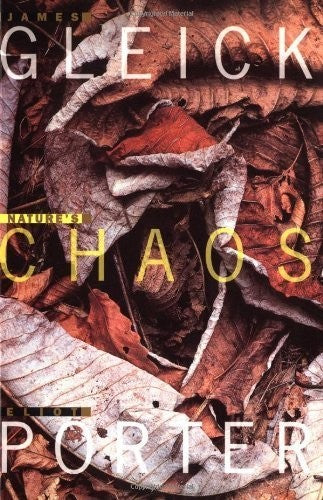
Nature's Chaos by James Gleick
This book, a companion to the textbook, Understanding Physics, is your guide to observations and explorations in the world of physics. Prepare for ch- lenging work, fun, and some surprises. One of the best ways to learn physics is by doing physics, in the laboratory and everywhere. One cannot rely on reading and class work alone. The explorations in this book are your - portunity to gain some actual, hands-on experience with physics. Many of these explorations will assist you to design your own experiments and to discover many of the important ideas of science yourself. As you will see from the Contents, this Student Guide provides a variety of potentially helpful materials. Following the Introduction is a review of units, mathematics, and scientific notation, and a list of suggested further reading and Web Sites. However, a large portion of the Student Guide c- tains further materials relating to many of the textbook chapters, as well as to laboratory explorations. In the section containing Further Chapter - terials you will find elaborations on topics in many of the chapters, as well as derivations of important equations. A complete list of the suggested mi- and major-laboratory explorations is also given in the Contents. Each - ploration is keyed to specific portions of the textbook, and lists are also provided of the explorations pertaining to each part of the text.
Eliot Porter (1901-1990) was an icon of American photography, most often associated with his outstanding, large-format, color photographs of the natural world. Porter began his education at Harvard University but left the school to devote his life to his photography and to champion the cause of the environment, long before such matters were recognized as important.
In 1962, Porter created in In Wildnerness Is the Preservation of the World, an immensely popular book combining his evocative, color photographs of New England woods with excerpts from the writings of Henry David Thoreau. The book revolutionized photographic book publishing by setting new standards for design and printing, and proving the commercial viability of fine art photography books. Its success set Porter on a lifelong path of creating similar photographic portraits of a wide variety of ecologically significant places the world over.
Porter's fascination with nature's workings and strong environmentalist ethic never suspended his passion for art. Throughout his life, Porter remained committed to making and exhibiting meticulously rendered dye transfer color prints of his photographs featured in many solo shows, including the American Museum of Natural History, Museum of Modern Art, and the first, one-person show of color photographs presented by the Metropolitan Museum of Art.
Henry David Thoreau (1817-1862) was an American author, poet, philospher, abolitionist, and environmentalist. He is best known for his book Walden, a reflection upon simple living in natural surroundings, and his essay Civil Disobedience, an argument for individual resistance to civil government in moral opposition to an unjust state.
In 1962, Porter created in In Wildnerness Is the Preservation of the World, an immensely popular book combining his evocative, color photographs of New England woods with excerpts from the writings of Henry David Thoreau. The book revolutionized photographic book publishing by setting new standards for design and printing, and proving the commercial viability of fine art photography books. Its success set Porter on a lifelong path of creating similar photographic portraits of a wide variety of ecologically significant places the world over.
Porter's fascination with nature's workings and strong environmentalist ethic never suspended his passion for art. Throughout his life, Porter remained committed to making and exhibiting meticulously rendered dye transfer color prints of his photographs featured in many solo shows, including the American Museum of Natural History, Museum of Modern Art, and the first, one-person show of color photographs presented by the Metropolitan Museum of Art.
Henry David Thoreau (1817-1862) was an American author, poet, philospher, abolitionist, and environmentalist. He is best known for his book Walden, a reflection upon simple living in natural surroundings, and his essay Civil Disobedience, an argument for individual resistance to civil government in moral opposition to an unjust state.
| SKU | Unavailable |
| ISBN 13 | 9780316609425 |
| ISBN 10 | 0316609420 |
| Title | Nature's Chaos |
| Author | James Gleick |
| Condition | Unavailable |
| Binding Type | Paperback |
| Publisher | Little, Brown & Company |
| Year published | 2001-10-31 |
| Number of pages | 128 |
| Cover note | Book picture is for illustrative purposes only, actual binding, cover or edition may vary. |
| Note | Unavailable |