


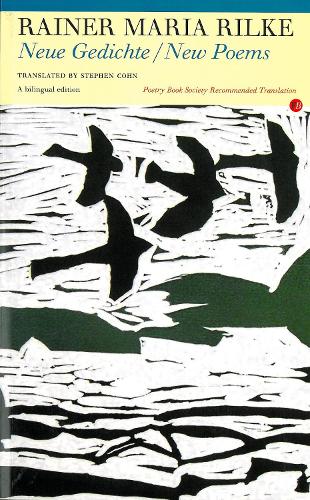
Neue Gedichte / New Poems by Rainer Maria Rilke
Rainer Maria Rilke (1875-1926), the greatest German language poet since Goethe, worked for a time as Rodin's secretary at Meudon. This title is a paperback edition of Stephen Cohn's celebrated translations and includes the complete German language text parallel with the English.
"Snow may be the best translator that Rilke has ever had" --Brian Phillips, "The New Republic"
RAINER MARIA RILKE was born in Prague in 1875. Following an unhappy period spent at military academies, he studied a variety of subjects at the universities of Prague, Munich, and Berlin. It was in Munich that he first met Lou Andreas-Salomé, with whom he travelled to Russia in 1899 and 1900. In 1901 he married Klara Westhoff, briefly a student of Auguste Rodin. Rilke himself became Rodin's secretary, installed at the Villa des Brillants at Meudon near Paris, and published two monographs on the sculptor, in 1903 and 1907. A number of major works belong to Rilke's years in Paris, including Parts I and II of the Neue Gedichte and the experimental novel Die Aufzeichnungen des Malte Laurids Brigge (The Notebooks of Malte Laurids Brigge, 1910). For much of his life Rilke led a nomadic existence, travelling widely and often supported by the hospitality of friends and patrons. Towards the end of his life he settled at the Château de Muzot in the Swiss Valais, where in 1923, in a whirlwind of creativity, he completed the Duineser Elegien (Duino Elegies) as well as Die Sonnette an Orpheus (Sonnets to Orpheus). The Elegies were inspired by a visit to Castle Duino on the Adriatic, while the Sonnets are dedicated to the memory of a young dancer, the daughter of friends. Rilke died at Valmont in the last days of 1926.
For more information on Rilke and on Cohn, his translator, go to rainermariarilke.net. Stephen Cohn was a sculptor, painter and printmaker. His translations of Rilke for Carcanet include the Duino Elegies and Sonnets to Orpheus.
For more information on Rilke and Cohn, go to rainermariarilke.net.
| SKU | Unavailable |
| ISBN 13 | 9781857547702 |
| ISBN 10 | 1857547705 |
| Title | Neue Gedichte / New Poems |
| Author | Rainer Rilke |
| Condition | Unavailable |
| Binding Type | Paperback |
| Publisher | Carcanet Press Ltd |
| Year published | 2004-07-29 |
| Number of pages | 240 |
| Cover note | Book picture is for illustrative purposes only, actual binding, cover or edition may vary. |
| Note | Unavailable |