


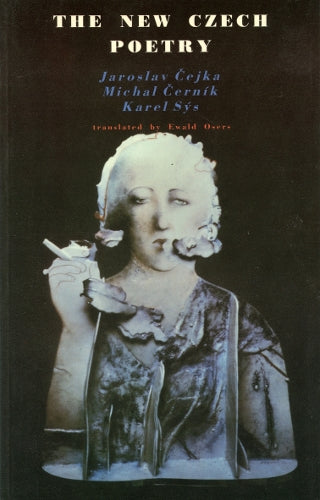
The New Czech Poetry by Jaroslav Cejka
Three leading Czech poets from the generation after Miroslav Holub: all born during the 1940s and now in mid-career. Jaroslav Cejka is an engineer and an experimental dramatist. His 12 Laws of the Heart are gently humorous poems which apply the language of scientific and other laws to emotions and human relationships, with startling results. Michal Cernik's poems show a strong sense of history, family and landscape, and many are monologues - spoken by a stone, a jug, a rose, an apple, a mirror, a mountain, the sky. The sensuous, playful poetry of Karel Sys's, the oldest of the three, is remarkable for its distinctive vision and its direct language, being influenced on the one hand by French poets like Rimbaud and Apollinaire, and preoccupied on the other with Raymond Chandler's America. This book shows the extraordinary diversity and vigour of the new Czech poetry. A companion volume, Vladimir Janovic's House of the Tragic Poet, is published at the same time.
Jaroslav Cejka, born 1943, was involved, during and after his engineering studies, with experimental studio theatre and for a while worked as a stage-hand at one of the big theatres in Prague. He increasingly drifted into cultural and literary work, and in 1982, when Kmen, the literary supplement of the weekly Tvorba, was founded, became its first editor-in-chief. He started to publish his poetry in 1964, and although his work appeared in periodicals and in anthologies, his first independent volume Sentimental Loves did not appear until 1979. The title is meant ironically: the poetry is in fact quite unsentimental. His next volume, Public Secret, published in 1980, is largely a private mirror of a sadly ending and ended love affair - poetry captivating by the very absence of sentimentality and self-pity. While the first two books are written in a regular (though not classical) form with frequent rhymes, Cejka abandoned this style in his Book of Requests and Complaints and adopted a free verse - almost as if he wanted to lead die reader away from excessive concern with himself to concern with life and the world. He went even further in that direction in his highly original next volume, his Pocket Collection of Laws, Axioms and Definitions, in which he applies the language of physical and other laws to human relationships. The gentle humour of this approach - which seems to owe something to Miroslav Holub - proved highly effective, largely because the basic natural laws used by Cejka are familiar to readers and are here suddenly applied, in a novel fashion, to a world of relationships and emotions normally beyond the scope of the natural sciences. Michal Cernik, born 1943, is the youngest poet to be honoured with the title 'Meritorious Artist', awarded to him in 1985. After extensive publication of his poetry in periodicals, his first volume, Spare Landscape, only appeared in 1971. The central part of this collection consists of monologues - by a stone, a jug, a rose, an apple, a mirror, a mountain, and the sky; all these reflect his intimate relationship with the landscape, the North Bohemian plain with the legendary Rip Hill rising from it. There is in his poetry a strong sense of family, or indeed clan, identity across the generations. Whereas, on the one hand, Cernik's language is sparse, economical, there is, on the other, a tendency towards lengthy lyrical-epic cycles evoking the mystique of family and home. Far is the Shadow, Far is the Garden (1979) reflects his generation relationship, his respect for the generations of his ancestors and his own, and his generation's, participation in the shaping of history. While Cernik's poetry for adults is marked by seriousness, and often gravitas, his children's verse (numerous volumes) as well as his prose for children and young readers, reveal a sense of humour and delight in play. Cernik has also translated Estonian and Lithuanian poetry, for anthologies published in 1977 and 1982, as well as - from literal translations by scholars - ancient Egyptian love lyrics (Ancient Love Songs, 1982). Karel Sys, born 1946, made his poetic debut in a literary periodical in 1965. Even his early poetry bore the characteristics which were to emerge more clearly as his work matured - a sensuous language, direct and outspoken, full of enchantment with life and rejecting all hypocrisy and puritanism. His first volume of poetry, Newton during the Failure of the Apple Crop, came out in 1969. This was followed, in 1972, by The Half-Open Angel, a volume of playful imagery, strongly reminiscent of Rimbaud. For the next few years Sys published only in periodicals, until in 1977 two new volumes of poetry appeared, The Long Farewell and Take a Deep Breath and Fly. The former, a deliberate echo of the title of Raymond Chandler's detective story, reflected Sys's belief that Chandler and his Philip Marlowe probably knew more about the real America than did Hemingway. The latter of the two volumes was republished, in amplified form, in 1979. By the early seventies Sys's poetry had found a considerable circle of readers and was influencing some of the poets of his own and the next younger generation. In 1978 a selection of his love poems was published under the title Carrier Pigeons of Memory and in 1981 - when he was only 35 - a Selected Poems. Karel Sys has also translated a lot of poetry, mostly with the help of intermediary versions: from Hungarian, Mongolian, Bulgarian, Lithuanian, and especially French. Two volumes of translations from Apollinaire testify, as does his own poetry, to the affinity he feels for the French poet. Among Czech poets of an earlier generation it is mainly Vitezslav Nezval who has left a clear mark on Sys's work. His Time Machine (1984) was hailed by reviewers as his best book so far.
| SKU | Unavailable |
| ISBN 13 | 9781852240660 |
| ISBN 10 | 1852240660 |
| Title | The New Czech Poetry |
| Author | Jaroslav Cejka |
| Condition | Unavailable |
| Binding Type | Paperback |
| Publisher | Bloodaxe Books Ltd |
| Year published | 1988-08-25 |
| Number of pages | 80 |
| Cover note | Book picture is for illustrative purposes only, actual binding, cover or edition may vary. |
| Note | Unavailable |