


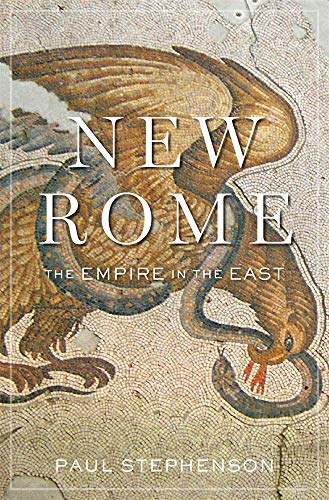
New Rome by Paul Stephenson
A comprehensive new history of the Eastern Roman Empire based on the science of the human past. As modern empires rise and fall, ancient Rome becomes ever more significant. We yearn for Rome’s power but fear Rome’s ruin—will we turn out like the Romans, we wonder, or can we escape their fate? That question has obsessed centuries of historians and leaders, who have explored diverse political, religious, and economic forces to explain Roman decline. Yet the decisive factor remains elusive. In New Rome, Paul Stephenson looks beyond traditional texts and well-known artifacts to offer a novel, scientifically minded interpretation of antiquity’s end. It turns out that the descent of Rome is inscribed not only in parchments but also in ice cores and DNA. From these and other sources, we learn that pollution and pandemics influenced the fate of Constantinople and the Eastern Roman Empire. During its final five centuries, the empire in the east survived devastation by natural disasters, the degradation of the human environment, and pathogens previously unknown to the empire’s densely populated, unsanitary cities. Despite the Plague of Justinian, regular “barbarian” invasions, a war with Persia, and the rise of Islam, the empire endured as a political entity. However, Greco-Roman civilization, a world of interconnected cities that had shared a common material culture for a millennium, did not. Politics, war, and religious strife drove the transformation of Eastern Rome, but they do not tell the whole story. Braiding the political history of the empire together with its urban, material, environmental, and epidemiological history, New Rome offers the most comprehensive explanation to date of the Eastern Empire’s transformation into Byzantium.
[A] major contribution to our knowledge of the sheer richness and importance of the world of East Rome in its initial headlong centuries…Brings the world of New Rome alive with exceptional learning and a magnificent openness to modern scientific methods that breathe life into conventional narratives of political and social history…Stephenson’s approach takes us directly into the heart of East Roman society-- Peter Brown * New York Review of Books *
The eastern Mediterranean witnessed major turbulence and transformation between the fifth and seventh centuries: climate change, wars, plague, religious strife, the end of classical antiquity, and the rise of Islam. In this striking new history, Stephenson gives us a portrait of Byzantium that is informed by environmental science and the material records left behind by the men and women of New Rome. Conventional histories of the last days of the Roman Empire will no longer suffice after you read this book. -- Averil Cameron, author of Byzantine Matters
How did the Eastern Roman Empire of late antiquity become the civilization known as Byzantium? Stephenson’s New Rome is the most compelling fusion yet of narrative history with the recent findings of environmental research and scientific data. It will change the way we understand key events and transformations in the Eastern Empire. -- Anthony Kaldellis, author of Romanland
Stephenson…has a wonderfully sharp eye for data and detail…Anyone who has shrugged at the suggestion that the weather had anything to do with the demise of such a mighty empire will, I think, come away from this book persuaded that climate change and natural disasters provide an important part of the answer. Far from being moralistic and attempting to apply the examples of the past as a warning, Stephenson lays down the evidence unemotionally, and lets it speak for itself…A sobering but fascinating history. Not for a long time has a book surprised me as much as this one did…I have been quoting passages and surprising facts to everyone around me ever since putting it down. -- Daisy Dunn * The Critic *
A genuinely new way of looking at later Late Antiquity, firmly anchoring the old stories of emperors and barbarians in their physical and environmental context. Stephenson’s gift for narrative is matched by an eye for arresting images and quirky anecdotes that will surprise and delight even jaded readers. -- Michael Kulikowski, author of The Tragedy of Empire
Casts brilliant shafts of light on the material conditions and spiritual quests of the ruling and the ruled in the Mediterranean world of Late Antiquity. Long-studied monuments and texts are fused with Egyptian papyri and fresh scientific data on habitats and climate change to present a masterly synthesis. -- Jonathan Shepard, editor of The Cambridge History of the Byzantine Empire
A sweeping survey of the disintegration of the western Roman empire and the emergence of Byzantium…Stephenson draws on the ‘new science of Roman history’ to reveal how climate change, pandemics, invading tribes, and near-constant warfare led to the decline of ancient cities…This impressive chronicle offers an eye-opening perspective on a period of dramatic change. * Publishers Weekly *
Centers on the Byzantine world in the period 395–700 A.D., combining modern scientific methods with traditional history to explain which parts of Rome migrated east and what became of them. * New Criterion *
This early history of Byzantium is sure to be enjoyed by a wide audience. * Choice *
The eastern Mediterranean witnessed major turbulence and transformation between the fifth and seventh centuries: climate change, wars, plague, religious strife, the end of classical antiquity, and the rise of Islam. In this striking new history, Stephenson gives us a portrait of Byzantium that is informed by environmental science and the material records left behind by the men and women of New Rome. Conventional histories of the last days of the Roman Empire will no longer suffice after you read this book. -- Averil Cameron, author of Byzantine Matters
How did the Eastern Roman Empire of late antiquity become the civilization known as Byzantium? Stephenson’s New Rome is the most compelling fusion yet of narrative history with the recent findings of environmental research and scientific data. It will change the way we understand key events and transformations in the Eastern Empire. -- Anthony Kaldellis, author of Romanland
Stephenson…has a wonderfully sharp eye for data and detail…Anyone who has shrugged at the suggestion that the weather had anything to do with the demise of such a mighty empire will, I think, come away from this book persuaded that climate change and natural disasters provide an important part of the answer. Far from being moralistic and attempting to apply the examples of the past as a warning, Stephenson lays down the evidence unemotionally, and lets it speak for itself…A sobering but fascinating history. Not for a long time has a book surprised me as much as this one did…I have been quoting passages and surprising facts to everyone around me ever since putting it down. -- Daisy Dunn * The Critic *
A genuinely new way of looking at later Late Antiquity, firmly anchoring the old stories of emperors and barbarians in their physical and environmental context. Stephenson’s gift for narrative is matched by an eye for arresting images and quirky anecdotes that will surprise and delight even jaded readers. -- Michael Kulikowski, author of The Tragedy of Empire
Casts brilliant shafts of light on the material conditions and spiritual quests of the ruling and the ruled in the Mediterranean world of Late Antiquity. Long-studied monuments and texts are fused with Egyptian papyri and fresh scientific data on habitats and climate change to present a masterly synthesis. -- Jonathan Shepard, editor of The Cambridge History of the Byzantine Empire
A sweeping survey of the disintegration of the western Roman empire and the emergence of Byzantium…Stephenson draws on the ‘new science of Roman history’ to reveal how climate change, pandemics, invading tribes, and near-constant warfare led to the decline of ancient cities…This impressive chronicle offers an eye-opening perspective on a period of dramatic change. * Publishers Weekly *
Centers on the Byzantine world in the period 395–700 A.D., combining modern scientific methods with traditional history to explain which parts of Rome migrated east and what became of them. * New Criterion *
This early history of Byzantium is sure to be enjoyed by a wide audience. * Choice *
Paul Stephenson is a historian of late antiquity and the author of Constantine: Roman Emperor, Christian Victor.
| SKU | Unavailable |
| ISBN 13 | 9780674659629 |
| ISBN 10 | 0674659627 |
| Title | New Rome |
| Author | Paul Stephenson |
| Series | History Of The Ancient World |
| Condition | Unavailable |
| Binding Type | Hardback |
| Publisher | Harvard University Press |
| Year published | 2022-02-08 |
| Number of pages | 464 |
| Prizes | Long-listed for Runciman Award 2023 (United States) |
| Cover note | Book picture is for illustrative purposes only, actual binding, cover or edition may vary. |
| Note | Unavailable |