


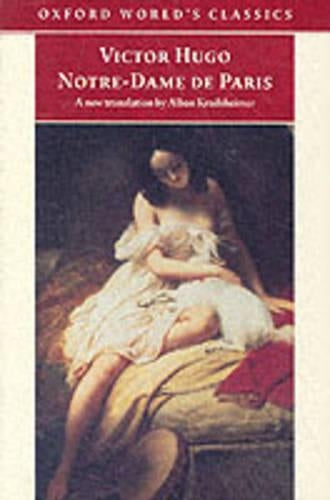
Notre Dame de Paris by Victor Hugo
Three extraordinary characters caught in a web of fatal obsession are at the centre of Hugo's novel. The grotesque hunchback Quasimodo, bell-ringer of Notre-Dame, owes his life to the austere archdeacon, Claude Frollo, who in turn is bound by a hopeless passion to the gypsy dancer Esmeralda. She, meanwhile, is bewitched by a handsome, empty-headed officer, but by an unthinking act of kindness wins Quasimodo's selfless devotion. Behind the central figures moves a pageant of picturesque characters, ranging from the cruel, superstitious king, Louis XI, to the underworld of beggars and petty criminals. These disreputable truands' night-time assault on the cathedral is one of the most spectacular set-pieces of Romantic literature. Hugo vividly depicts medieval Paris, where all life is dominated by the massive cathedral. His passionate enthusiasm for Gothic architecture is set within the context of an epic view of mankind's history, to which he attaches even more importance than to the novel's compelling story. Alban Krailsheimer's new translation is a fresh approach to this monumental classic by France's most celebrated Romantic.Lee Fahnestock and Norman MacAfee have translated two volumes of the letters of Jean-Paul Sartre, edited by Simone de Beauvoir: Witness to My Life and Quiet Moments in a War. For their work together, they have received an NEA Translation fellowship and the American Literary Translators Association Award. Lee Fahnestock has translated fiction as well as four volumes of the poetry of Francis Ponge, including The Making of the Pre and The Nature of Things. The French Government honored her with the Chevalier de l'ordre des arts et des lettres. Norman MacAfee's other books include One Class: Selected Poems; The Gospel According to RFK: Why It Matters Now; the opera The Death of the Forest; and translations of Pier Paolo Pasolini's poetry.
| SKU | Unavailable |
| ISBN 13 | 9780192837011 |
| ISBN 10 | 019283701X |
| Title | Notre Dame de Paris |
| Author | Victor Hugo |
| Series | Oxford World's Classics |
| Condition | Unavailable |
| Binding Type | Paperback |
| Publisher | Oxford University Press |
| Year published | 1999-09-02 |
| Number of pages | 592 |
| Cover note | Book picture is for illustrative purposes only, actual binding, cover or edition may vary. |
| Note | Unavailable |