
O My Hornby and My Barlow Long Ago


Summary
The feel-good place to buy books
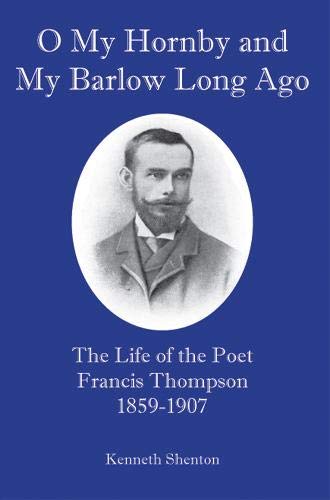
O My Hornby and My Barlow Long Ago by Kenneth Shenton
2019 marks the 160th anniversary of the birth of the once celebrated, but now sadly neglected Preston born poet, Francis Thompson. During his short and eventful life, perhaps no writer has suffered more for his art. A Roman Catholic, he was judged unsuitable for ordination, regularly failed his medical examinations and was rejected as a soldier. Following a family argument, he left home to live in London. Having already fallen prey to opium addiction, he followed the path prescribed by an earlier Lancastrian, Thomas de Quincey, who himself died exactly 160 years ago. Initially forced to live there as a destitute vagrant, the poet found himself, pitched between Heaven and Charing Cross. On more than one occasion, he even became a major suspect in the Jack the Ripper murders. However, thanks to the support of the publisher, Wilfred Meynell and his family, Thompson's extensive output of poetry and literary criticism eventually began to be published in the latter years of the nineteenth century. Central to his creative output was his Catholic faith, which he held so humbly and yet embellished so royally. Always confident of his vision, his message has possibly had to wait for a future age to be more widely understood. It was exactly one hundred years ago, when a British composer, Sir William Harris, now generally dismissed as merely occupying a minor role as a church musician, won a prestigious Carnegie Award for his extended setting for Baritone, Chorus and Orchestra of Francis Thompson's most famous creation, The Hound of Heaven. It is a stunning work, and though now sadly rarely performed, it remains one of the major choral masterpieces of 20th Century British music. In its day it inspired a number of fellow composers to follow suit and add their own highly distinctive musical vision to Thompson's poetry. However, it has not only been musicians who have been stimulated by Thompson's unique outlook. As this volume relates, numerous artists, writers and playwrights have also eagerly taken up the challenge. By yet a further coincidence, 1919 also marked the death of one of the most renowned Lancashire and England cricketers of his generation, a distinctive figure, here again, so movingly immortalized in verse by Francis Thompson, Richard Gorton Barlow. However, in writing about this veteran of forty seasons of first class cricket, it is impossible to ignore his opening partner and fellow run-stealer, The Boss, Albert Neilson Hornby. Thanks to the talents of Francis Thomson, they are irretrievably linked just as Gilbert and Sullivan go so effortlessly together within English opera. Hornby, the sprightly Cavalier amateur, careless of risk and carefree in assault, had genius, and if he very well knew it, he didn't really care. Barlow, the Roundhead professional, had skill, or more truly, he increased that talent into untold riches. Only a poet of rare and undoubted vision could have united them in such a memorable and moving way.
Fast approaching half a century of active involvement in the world of cricket, both as an umpire and administrator, Kenneth Shenton's earliest memories of the game are of his father opening the bowling for his local team, Nantwich, at that time based on The Barony, and playing a leading role in the life of The North Staffs and South Cheshire Cricket League. Astutely captained as always by their legendary and long serving wicket keeper, Geoff Bull, at that time the runs constantly flowed from the bat of the club's revered Indian test star, Gulabrai Sipahimalani Ramchand. Born, like his father, in the small Cheshire market town, Kenneth Shenton was educated at Edleston Road Primary School and Nantwich and Acton Grammar School. While there he studied the organ with the distinguished Organist of St Mary's Parish Church, Harold Kirkham. He then went on to read music at the University of London, before undertaking postgraduate studies at Keble College, Oxford. After teaching locally for some years, he then spent some thirty three years as Director of Music at one of the north west's leading independent schools. As a writer, a regular contributor to publications as diverse as The Cricketer and The Church Times, he also compiles obituaries for the national press. As a broadcaster, he has both written and narrated numerous documentary programmes across the air waves. These include everything from Promenade Concert interval talks on Radio Three, The Resort Without Peer on Radio Two and, on Radio Three, a centenary tribute to the eminent musicologist and composer, Elizabeth Poston, intriguingly titled Tinker, Tailor, Composer, Spy. His publications range from The Songs of C.B. Rootham to The Complete Organ Works of Basil Harwood. Married with two daughters, he lives on the Fylde Coast.
| SKU | Unavailable |
| ISBN 13 | 9780993487262 |
| ISBN 10 | 0993487262 |
| Title | O My Hornby and My Barlow Long Ago |
| Author | Kenneth Shenton |
| Condition | Unavailable |
| Binding Type | Paperback |
| Publisher | Max Books |
| Year published | 2019-11-18 |
| Number of pages | 172 |
| Cover note | Book picture is for illustrative purposes only, actual binding, cover or edition may vary. |
| Note | Unavailable |