


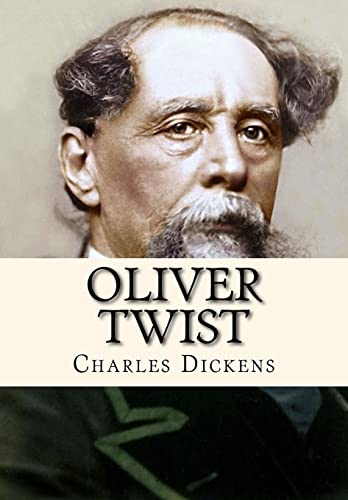
Oliver Twist by Dickens Charles Charles
Oliver Twist, subtitled The Parish Boy's Progress, is the second novel by English author Charles Dickens, published by Richard Bentley in 1838. The story is about an orphan, Oliver Twist, who endures a miserable existence in a workhouse and then is placed with an undertaker. He escapes and travels to London where he meets the Artful Dodger, leader of a gang of juvenile pickpockets. Naively unaware of their unlawful activities, Oliver is led to the lair of their elderly criminal trainer Fagin. Oliver Twist is notable for Dickens's unromantic portrayal of criminals and their sordid lives. The book exposed the cruel treatment of the many orphans in London during the Dickensian era. The book's subtitle, The Parish Boy's Progress, alludes to Bunyan's The Pilgrim's Progress and also to a pair of popular 18th-century caricature series by William Hogarth, A Rake's Progress and A Harlot's Progress. An early example of the social novel, the book calls the public's attention to various contemporary evils, including child labour, the recruitment of children as criminals, and the presence of street children. Dickens mocks the hypocrisies of his time by surrounding the novel's serious themes with sarcasm and dark humour. The novel may have been inspired by the story of Robert Blincoe, an orphan whose account of hardships as a child labourer in a cotton mill was widely read in the 1830s. It is likely that Dickens's own early youth as a child labourer contributed to the story's development.
Dickens, Charles: - Charles John Huffam Dickens wrote twenty novels, dozens of short stories and novellas, several plays and countless articles and essays during his long and eventful writing career. From the time that Charles Dickens' novels were first published, in serialized monthly or weekly installments, they have never gone out of print in the UK. Charles Dickens is often considered to be the greatest novelist of the Victorian era. Charles Dickens' colorful, if challenging, early life had a huge impact on his later works. Raised in poverty with little formal education, even working for a time as a child laborer, Charles' childhood on the harsh streets of London shaped his identity and fueled his creative drive. The harsh conditions he endured, the humiliation of running from his father's debts and his long daily walks around the poorest parts of London gave him first-hand experience of the world his colorful characters eventually inhabited. Charles' characters themselves, of course, were influenced by the rich cast of kind and evil, funny and tragic, rich and destitute people Charles came into contact with throughout his life. Charles novels revolutionized readership in the Victorian era and the serial publication schedule he preferred soon became the dominant mode for novel publication. Although providing a novel in weekly or monthly installments was a huge commitment for Charles, and a difficult one to pull off, this format allowed him to respond to feedback while writing and make adjustments to plot and character. Unlike some writers who closed themselves off from the world around them and worked in a solitary manner, favoring the internal world over the external, Charles was a social creature and by nature a multi-tasker. An indefatigable man, Charles wrote almost constantly from the time he tasted his first literary success with The Pickwick Papers to the day of his death. Charles was also a renowned philanthropist who campaigned vigorously for the rights of the most unfortunate in society. A social butterfly, Charles Dickens had countless friends including a number of prominent Victorian writers, artists, actors and businessmen. Before his death, Charles was even invited to a private audience with Queen Victoria, who was a fan of his work. The adjective, 'Dickensian' refers to something 'of or reminiscent of the novels of Charles Dickens, especially in suggesting the poor social conditions or comically repulsive characters that they portray.' That the work of Charles Dickens has spawned its own descriptive term demonstrates how fully it has permeated English culture, from the moment of its creation to the present day. Charles Dickens' life story can be read like one of his own novels with the man himself represented by different characters at different times. At first he is the poor child worker with a debt-ridden father, treading his rags to riches path on the chaotic and dirty London streets. Soon, he becomes a newspaper man who struggles to accept the injustice he sees in the law courts, in parliament, on the very streets he walks. Later, he is a cheerful father with a growing brood of children and a chaotic home life and further on in life he is a bachelor in the throes of a passionate and scandalous love affair with a younger woman. The best person to write the life of Charles Dickens would have been Charles himself but he has left that task to others. Living his life was exhausting enough.
| SKU | Unavailable |
| ISBN 13 | 9781503288416 |
| ISBN 10 | 1503288412 |
| Title | Oliver Twist |
| Author | Dickens Charles Charles |
| Condition | Unavailable |
| Binding Type | Paperback |
| Publisher | Createspace Independent Publishing Platform |
| Year published | 2014-11-29 |
| Number of pages | 262 |
| Cover note | Book picture is for illustrative purposes only, actual binding, cover or edition may vary. |
| Note | Unavailable |