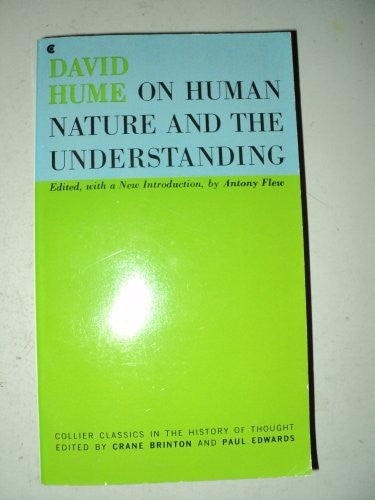
On Human Nature and Understanding by David Hume

On Human Nature and Understanding by David Hume

Regular price
Checking stock...
Regular price
Checking stock...
World of Books

At World of Books, you’ll find millions of preloved reads at great prices, from bestsellers to hidden gems. Every book you buy saves money and helps reduce waste, so you can read more for less while giving stories a second life.

The feel-good place to buy books
  • Free US shipping over $15
  • Buying preloved emits 41% less CO2 than new
  • Millions of affordable books
  • Give your books a new home - sell them back to us!

On Human Nature and Understanding by David Hume

The Professional Identity of Teacher Educators offers a contemporary study of teacher education in a period of huge international, institutional and professional change. The book explores the experiences, understandings, and beliefs that guide the professional practices of teacher educators, and paints a picture of a profession that offers huge rewards, alongside challenges and frustrations. What are the responsibilities of the job and how does it re-shape the professional identity of those who do it, day in, day out? What are the challenges and opportunities for teacher educators arising from constantly evolving education policies?

Drawing on the findings of a phenomenological study of the professional self-image and identities of pre-service teacher educators, this book provides an account of how a number of teacher educators have come to terms with their own identities as professionals at a time of considerable institutional turmoil. Moving beyond these individual stories, broader theoretical issues are also addressed: are there some distinctive but common elements that might distinguish the professional identity of the particular group we call teacher educators; and if there are, what might those characteristics be?

Included in the book:

  • identity and professional identity in teaching and teacher education
  • investigating a professional identity
  • the process of becoming a teacher educator
  • teacher educators' changing job descriptions in an era of reform
  • the distinctive knowledge-base and expertise of teacher educators'
  • teacher educators' self-image
  • teacher educators as a community of practice.

Ronnie Davey provides a unique and compelling report on cutting edge teacher education research, encapsulating the major issues associated with being a teacher educator, and how that influences and shapes teacher educators' identity. This book will be invaluable reading for teacher educators and researchers with an interest in professional identity and teaching in Higher Education.

Hume, David: - David Hume (/hjuːm/; born David Home; 7 May 1711 NS (26 April 1711 OS) - 25 August 1776)[9] was a Scottish Enlightenment philosopher, historian, economist, and essayist, who is best known today for his highly influential system of philosophical empiricism, scepticism, and naturalism.[1] Beginning with A Treatise of Human Nature (1739-40), Hume strove to create a naturalistic science of man that examined the psychological basis of human nature. Hume argued against the existence of innate ideas, positing that all human knowledge derives solely from experience. This places him with Francis Bacon, Thomas Hobbes, John Locke, and George Berkeley, as a British Empiricist.[10] Hume argued that inductive reasoning and belief in causality cannot be justified rationally; instead, they result from custom and mental habit. We never actually perceive that one event causes another, but only experience the constant conjunction of events. This problem of induction means that to draw any causal inferences from past experience it is necessary to presuppose that the future will resemble the past, a presupposition which cannot itself be grounded in prior experience.[11] An opponent of philosophical rationalists, Hume held that passions rather than reason govern human behaviour, famously proclaiming that Reason is, and ought only to be the slave of the passions.[10] Hume was also a sentimentalist who held that ethics are based on emotion or sentiment rather than abstract moral principle. He maintained an early commitment to naturalistic explanations of moral phenomena, and is usually taken to have first clearly expounded the is-ought problem, or the idea that a statement of fact alone can never give rise to a normative conclusion of what ought to be done.[12] Hume also denied that humans have an actual conception of the self, positing that we experience only a bundle of sensations, and that the self is nothing more than this bundle of causally-connected perceptions. Hume's compatibilist theory of free will takes causal determinism as fully compatible with human freedom.[13] His views on philosophy of religion, including his rejection of miracles and the argument from design for God's existence, were especially controversial for their time. Hume influenced utilitarianism, logical positivism, the philosophy of science, early analytic philosophy, cognitive science, theology, and many other fields and thinkers. Immanuel Kant credited Hume as the inspiration who had awakened him from his dogmatic slumbers.
SKU Unavailable
ISBN 13 9780020658306
ISBN 10 0020658303
Title On Human Nature and Understanding
Author David Hume
Condition Unavailable
Binding Type Paperback
Publisher Prentice Hall (a Pearson Education company)
Year published 1962-01-01
Number of pages 0
Cover note Book picture is for illustrative purposes only, actual binding, cover or edition may vary.