
On the Nature of the Universe


World of Books
The feel-good place to buy books
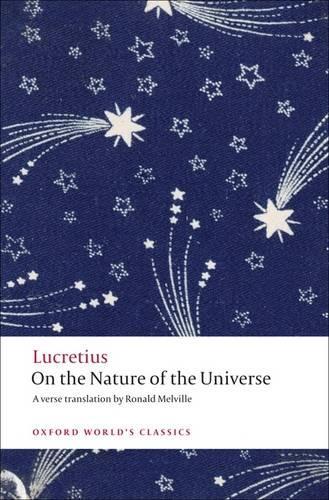
On the Nature of the Universe by Lucretius
`Therefore this terror and darkness of the mind Not by the sun's rays, nor the bright shafts of day, Must be dispersed, as is most necessary, But by the face of nature and her laws.' Lucretius' poem On the Nature of the Universe combines a scientific and philosophical treatise with some of the greatest poetry ever written. With intense moral fervour Lucretius demonstrates to humanity that in death there is nothing to fear since the soul is mortal, and the world and everything in it is governed not by the gods, but by the mechanical laws of nature. By believing this, men can live in peace of mind and happiness. Lucretius bases his argument on the atomic theory expounded by the Greek philosopher Epicurus. His poem explores sensation, sex, cosmology, meteorology, and geology through acute observation of the beauties of the natural world and with moving sympathy for man's place in it. Sir Ronald Melville's accessible and accurate verse translation is complemented by an introduction and notes situating Lucretius' scientific theories within the thought of 1st century BCE Rome and discussing the Epicurean philosophy that was his inspiration and why the issues Lucretius' poem raisies about the scientific and poetical views of the world continue to be important. ABOUT THE SERIES: For over 100 years Oxford World's Classics has made available the widest range of literature from around the globe. Each affordable volume reflects Oxford's commitment to scholarship, providing the most accurate text plus a wealth of other valuable features, including expert introductions by leading authorities, helpful notes to clarify the text, up-to-date bibliographies for further study, and much more.
TITUS LUCRETIUS CARUS, the Roman philosopher-poet and author of one work, De rerum natura (On the Nature of Things), was born around 95 BCE. Almost nothing is known of his life; even his birth and death dates remain open to conjecture. He may have been a member of the aristocratic family of the Lucretii, or else a freedman attached to the Lucretii family. The only uncontested fact about Lucretius's life has to do with his friendship with, or dependence upon, Gaius Memmius, the aristocratic patron of the poets Gaius Valerius Catullus and Gaius Helvius Cinna, for it is Memmius to whom Lucretius dedicates his poem. St. Jerome makes the extravagant claim that Lucretius had been poisoned by a love-philter, and that he composed his 7,400-line poem during his lucid intervals. (This apocryphal tale may be based on Lucretius's attack on erotic passion in book 4.) An anonymous life of Lucretius attached to an early edition of On the Nature of Things indicates that Lucretius was an intimate of Cicero, Cicero's friend Atticus, and Marcus Junius Brutus (the tyrranicide). This life is of doubtful authenticity; the only real connection with Cicero comes with Cicero's implication, in a letter to his brother, Quintus, that he has read the work, which was not published until after Lucretius's death. With his great poem, Lucretius took up the cause of Epicureanism at Rome, extolling its founder, Epicurus of Athens (341-271 B.C.E.), as our father, the revealer of truth, the giver of fatherly precepts. Lucretius saw himself as a strict follower of the master, although he sometimes avoided the more abstruse points of Epicurus's argument and substituted for the master's dry prose a wealth of vivid observations and imagery which mark him as a true poet, and which made Epicureanism more appealing to a wider audience. Much of Lucretius's poem, in six books, is concerned with detailing the atomic view of the universe. This includes discussion of the mechanical laws of nature, the mortality of the soul, and the moral theory that pleasure (meaning largely the absence of pain) is the goal of life. At the root of the discussion is the idea that atoms both eternal and infinite in number make up the physical universe, including the souls of humankind. However, while the universe is material, it is not deterministic: the swerve of atoms, a concept developed by Epicurus, accounts both for chance and for human free will. One of the benefits of Epicureanism came with its abolition of the superstitious fear that the gods intervene in human affairs, and that the soul is subject to punishment in an afterlife. Since the soul, composed of extremely fine atoms, dissolves with the death of the body, humankind need not fear an eternity of pain and suffering. Lucretius was taken up enthusiastically by educated Romans. But with the rise of Christianity, he was condemned for his denial of the soul's immortality and for teaching that pleasure is the end of life. Following a long period of neglect, Lucretius's work once more became a profound source of secular ideas, beginning with the revival of classical learning during the Renaissance. Lucretius died about 55 BCE.
| SKU | Unavailable |
| ISBN 13 | 9780199555147 |
| ISBN 10 | 0199555141 |
| Title | On the Nature of the Universe |
| Author | Lucretius |
| Series | Oxford World's Classics |
| Condition | Unavailable |
| Binding Type | Paperback |
| Publisher | Oxford University Press |
| Year published | 2008-10-09 |
| Number of pages | 320 |
| Cover note | Book picture is for illustrative purposes only, actual binding, cover or edition may vary. |
| Note | Unavailable |