
Optics and the Theory of Electrons


World of Books
The feel-good place to buy books
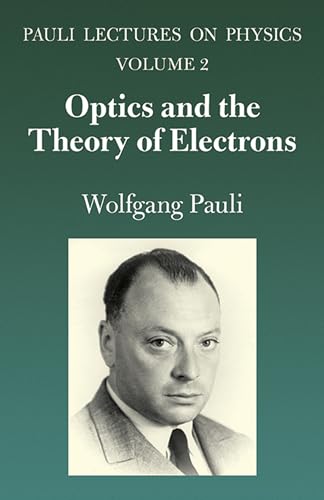
Optics and the Theory of Electrons by Wolfgang Pauli
Lectures on optics that serve as a concise and rewarding introduction to the topic.
These lectures covering topics basic to classical and modern physics were given by Wolfgang Pauli at the Swiss Federal Institute of Technology. The lectures on optics serve as a concise and rewarding introduction to the topic. From the introduction by Victor Weisskopf: Pauli's way of presenting physics is never out of date. The reason for this remarkable fact lies in Pauli's style, which is commensurate to the greatness of its subject in its clarity and impact. Style in scientific writing is a quality that today is on the point of vanishing. The pressure of fast publication is so great that people rush into print with hurriedly written papers and books that show little concern for careful formulation of ideas. Mathematical and instrumental techniques have become complicated and difficult; most of the effort of writing and learning is devoted to the acquisition of these techniques instead of insight into important concepts. Essential ideas of physics are often lost in the dense forest of mathematical reasoning. This situation need not be so. Pauli's lectures show how physical ideas can be presented clearly and in good mathematical form, without being hidden in formalistic expertise.
Wolfgang Pauli: The Young Genius
Wolfgang Pauli (1900-1958), Austrian by birth, was one of the most influential physicists of the twentieth century and winner of the 1945 Nobel Prize in Physics for the discovery of the Pauli exclusion principle in quantum mechanics. His classic work on relativity was first published in Germany in 1921, when Pauli was twenty-one years old. The physicist A. Sommerfeld wrote this in his Preface to the 1921 German edition of Pauli's work:
In view of the apparently insatiable demand, especially in Germany, for accounts of the Theory of Relativity, both of a popular and of a highly specialized kind, I felt I ought to advise the publishers to arrange for a separate edition of the excellent article by Herr W. Pauli, Jr., which appeared in the Encyklopadie der mathematischen Wissenschaften, Vol. V. Although Herr Pauli was still a student at the time he was not only familiar with the most subtle arguments in the Theory of Relativity through his own research work, but was also fully conversant with the literature of the subject.
First translated and published in English in 1958, and reprinted by Dover in 1981, Pauli's Theory of Relativity continues to find readers another fifty years later. In 2000, Dover reprinted the six volumes of Pauli's collected lectures on physics which had first been published by MIT: Electrodynamics (Volume 1), Optics and the Theory of Electrons (Volume 2), Thermodynamics and the Kinetic Theory of Gases (Volume 3), Statistical Mechanics (Volume 4), Wave Mechanics (Volume 5), and Selected Topics in Field Quantization (Volume 6).
In 1928, Pauli, not yet thirty years old, was appointed Professor of Theoretical Physics at ETH Zurich where he did much of his most important work. Following Germany's takeover of Austria in 1938, and the outbreak of World War II in 1939, Pauli emigrated to the United States where he was Professor of Theoretical Physics at Princeton. In 1946, he became a naturalized American citizen before returning to Zurich, where he mostly lived for the last decade of his life.
| SKU | Unavailable |
| ISBN 13 | 9780486414584 |
| ISBN 10 | 0486414582 |
| Title | Optics and the Theory of Electrons |
| Author | Wolfgang Pauli |
| Series | Dover Books On Physics |
| Condition | Unavailable |
| Binding Type | Paperback |
| Publisher | Dover Publications Inc. |
| Year published | 2003-03-28 |
| Number of pages | 192 |
| Cover note | Book picture is for illustrative purposes only, actual binding, cover or edition may vary. |
| Note | Unavailable |