


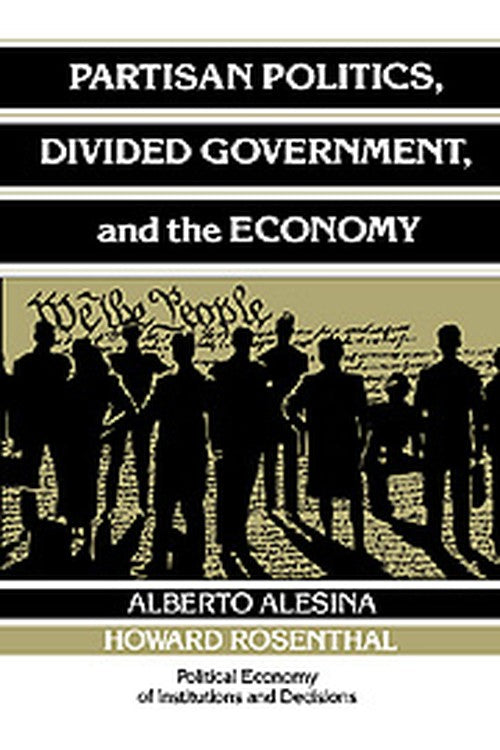
Partisan Politics, Divided Government, and the Economy by Alberto Alesina
This book develops an integrated approach to understanding the American economy and national elections. Economic policy is generally seen as the result of a compromise between the President and Congress. Because Democrats and Republicans usually maintain polarised preferences on policy, middle-of-the-road voters seek to balance the President by reinforcing in Congress the party not holding the White House. This balancing leads, always, to relatively moderate policies and, frequently, to divided government. The authors outline the rational partisan business cycle, where Republican administrations begin with recessions, and Democratic ones with expansions, and the midterm cycle, where the President's party loses votes in the midterm congressional election. The book argues that both cycles are the result of uncertainty about the outcome of presidential elections. Other topics covered include retrospective voting on the economy, coat-tails, and incumbency advantage.
"..a challenging and important work...in this key area of interdisciplinary research, Alesina and Rosenthal's multi-faceted formal arguments and empirical tests are likely to set the standard for many years." Keith Krehbiel, Stanford University
"Alesina and Rosenthal bring together two major themes in the current study of American politics--divided government and the political business cycle. In so doing, they develop a theoretically innovative, statistically well-grounded model of the United States political economy. A strong round of applause is in order." Michael S. Lewis-Beck, Professor, the University of Iowa
"Alesina and Rosenthal have made what will surely be an enduring contribution....This book represents a genuine advance in the political business cycle literature....This book is accessible and holds value for both economists and political scientists. It should prove very useful to graduate students, but will also be stimulating to readers who are already familiar with the existing literature on political business cycles. This book would make a nice addition to a graduate seminar on applied political economy; any course which covers political business cycles would be incomplete absent this book as a required text." Jeffrey Milyo, Journal of Politics
"Alesina and Rosenthal bring together two major themes in the current study of American politics--divided government and the political business cycle. In so doing, they develop a theoretically innovative, statistically well-grounded model of the United States political economy. A strong round of applause is in order." Michael S. Lewis-Beck, Professor, the University of Iowa
"Alesina and Rosenthal have made what will surely be an enduring contribution....This book represents a genuine advance in the political business cycle literature....This book is accessible and holds value for both economists and political scientists. It should prove very useful to graduate students, but will also be stimulating to readers who are already familiar with the existing literature on political business cycles. This book would make a nice addition to a graduate seminar on applied political economy; any course which covers political business cycles would be incomplete absent this book as a required text." Jeffrey Milyo, Journal of Politics
Alesina, Alberto: - Alberto Alesina is Nathaniel Ropes Professor of Political Economics at Harvard University. He is the coauthor (with Enrico Spolaore) of The Size of Nations (MIT Press, 2003).
| SKU | Unavailable |
| ISBN 13 | 9780521436205 |
| ISBN 10 | 0521436206 |
| Title | Partisan Politics, Divided Government, and the Economy |
| Author | Alberto Alesina |
| Series | Political Economy Of Institutions And Decisions |
| Condition | Unavailable |
| Binding Type | Paperback |
| Publisher | Cambridge University Press |
| Year published | 1995-01-27 |
| Number of pages | 300 |
| Cover note | Book picture is for illustrative purposes only, actual binding, cover or edition may vary. |
| Note | Unavailable |