


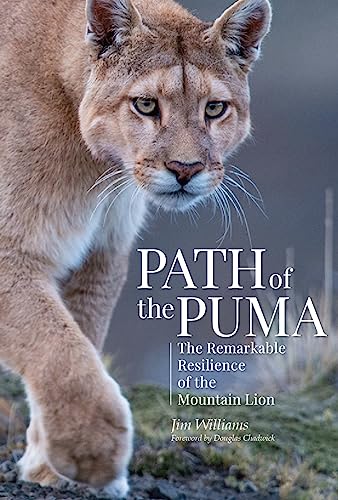
Path of the Puma by Jim Williams
“These cats are like emissaries from the raw landscapes out West, probing the rest of the nation, showing us where patches of wildness remain, and bring a fuller dimension of wildness to them. It’s as if they’re testing to find out just what folks have in mind when they say they want to preserve natural settings. How natural? How toothy?” -- From the Foreword During a time when most wild animals are experiencing decline in the face of development and climate change, the intrepid mountain lion -- also known as a puma, a cougar, and by many other names – has experienced reinvigoration as well as expansion of territory. What makes this cat, the fourth carnivore in the food chain -- just ahead of humans – so resilient and resourceful? And what can conservationists and wild life managers learn from them about the web of biodiversity that is in desperate need of protection? Their story is fascinating for the lessons it can afford the protection of all species in times of dire challenge and decline. With hands-on experience in both the Rocky Mountains and the wilds of Patagonia in South America, wildlife manager Jim Williams tracks the path of the puma, and in doing so, challenges readers to consider humans’ role in this journey as well as what commitment to nature and conservation means in this day and age.
Written in accurate yet easy-to-understand scientific language, Williams’s heartfelt and comprehensive offering will appeal not only to wildlife biologists, but to nature lovers everywhere-- Publishers Weekly
Jim Williams's fascinating and inspiring Path of the Puma tracks mountain lions and their place in the ecosystem, showing what can be done to preserve their habitat while enjoying our own. -- Foreword Reviews
Starred Review "The author's passion and his firsthand knowledge of his subject make the narrative highly readable. . . . A handsome book that is well-balanced, instructive, and authoritative." -- Kirkus Reviews
There’s a success story to be told, but it’s one with a mixed outcome, he notes. “America’s vast public lands, and Patagonia’s newly conserved parks, are a bulwark against the crush of humanity,” writes Williams. “But the trajectory—despite the recent success and expansion of Puma concolor —is toward more people and less wild nature. Predators will continue to prey on livestock. Ungulates will continue to compete for grass. Mountain lions will continue to prey on pets. Subdivisions will continue to consume habitat. Hunters will continue to compete with carnivores. Game managers will continue to be pressured by hunters.” -- National Parks Traveler
"Suggested Episode: Path of the Puma is a great place to start and will give you a sense of the great lion of North and South America and the people who care deeply about its survival." -- UpRoxx.com (about author interview on Meateater's podcast)
"...the main purpose of Path of the Puma, according to Williams, is to 'inspire people about wild things and wild places.' To that end, the book is an absolute page-turning success." "Peppered with gorgeous wildlife photography, the book is equal parts high-stakes adventure story, personal memoir, and, of course, mountain lions. . . . Like the big cats at the heart of it, Path of the Puma is a truly exceptional and important creation." -- Santa Barbara Independent
Jim Williams's fascinating and inspiring Path of the Puma tracks mountain lions and their place in the ecosystem, showing what can be done to preserve their habitat while enjoying our own. -- Foreword Reviews
Starred Review "The author's passion and his firsthand knowledge of his subject make the narrative highly readable. . . . A handsome book that is well-balanced, instructive, and authoritative." -- Kirkus Reviews
There’s a success story to be told, but it’s one with a mixed outcome, he notes. “America’s vast public lands, and Patagonia’s newly conserved parks, are a bulwark against the crush of humanity,” writes Williams. “But the trajectory—despite the recent success and expansion of Puma concolor —is toward more people and less wild nature. Predators will continue to prey on livestock. Ungulates will continue to compete for grass. Mountain lions will continue to prey on pets. Subdivisions will continue to consume habitat. Hunters will continue to compete with carnivores. Game managers will continue to be pressured by hunters.” -- National Parks Traveler
"Suggested Episode: Path of the Puma is a great place to start and will give you a sense of the great lion of North and South America and the people who care deeply about its survival." -- UpRoxx.com (about author interview on Meateater's podcast)
"...the main purpose of Path of the Puma, according to Williams, is to 'inspire people about wild things and wild places.' To that end, the book is an absolute page-turning success." "Peppered with gorgeous wildlife photography, the book is equal parts high-stakes adventure story, personal memoir, and, of course, mountain lions. . . . Like the big cats at the heart of it, Path of the Puma is a truly exceptional and important creation." -- Santa Barbara Independent
Jim Williams has spent his entire life finding the wild. Jim left the farm country of Iowa and spent his formative years as a young surf bum turned biology student in the Pacific Beach area of San Diego. He did his undergraduate work at San Diego State and Florida State Universities and his graduate studies at Montana State University in Bozeman. Jim is an award-winning, professionally certified wildlife biologist and has been working for Montana Fish, Wildlife and Parks for 25 years. Jim studied mountain lion ecology for his Master's Degree on Montana's Rocky Mountain Front and has been working on mountain lion and other wildlife conservation issues in various roles ever since. He has been working with biologists in Chile and Argentina on a variety of wildlife conservation projects. Jim and his wife Melora live and work in Montana’s beautiful Flathead Valley just west of Glacier National Park. Joe Glickman was the author of Fearless: One Woman, One Kayak, One Continent (Falcon Guide, 2012), The Kayak Companion (Storey, 2003), and To the Top (Northword, 2003). Glickman's work has appeared in The New York Times, The Daily News, Newsday, The Village Voice, Outside, Men's Journal, Inside Sports, Adventure Cyclist, Runner's World, US, EcoTraveler, The Paddler, Sea Kayaker, Women's Sports & Fitness, and Brooklyn Bridge. He co-wrote (with Allen Barra) That's Not the Way It Was, a book about myths in sports. A wildlife biologist who studied mountain goats and grizzlies in the Rockies, elephants in Africa, and whales in the world's oceans, Doug Chadwick also writes about natural history, conservation, and wildlife around the world, from right whales in the sub-Antarctic to snow leopards in the Himalayas, producing close to fifty articles for National Geographic magazine. In addition, he has written thirteen books about wildlife and conservation, including The Wolverine Way, Tracking Gobi Grizzlies, Yellowstone to Yukon and the lead chapter in Crown of the Continent: The Wildest Rockies, a photographic celebration of the region's wildlife and scenic majesty.
| SKU | Unavailable |
| ISBN 13 | 9781938340727 |
| ISBN 10 | 1938340728 |
| Title | Path of the Puma |
| Author | Jim Williams |
| Condition | Unavailable |
| Binding Type | Hardback |
| Publisher | Patagonia Books |
| Year published | 2018-11-22 |
| Number of pages | 288 |
| Prizes | Commended for Benjamin Franklin Award (Animals/Pets) 2019 |
| Cover note | Book picture is for illustrative purposes only, actual binding, cover or edition may vary. |
| Note | Unavailable |