


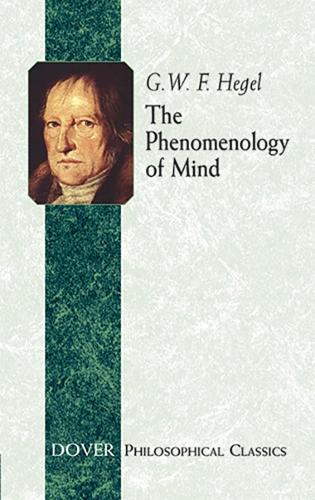
The Phenomenology of Mind by Georg Wilhelm Friedrich Hegel
Remarkable for its breadth and profundity, this work combines aspects of psychology, logic, moral philosophy, and history to form a comprehensive view that encompasses all forms of civilization. Its three divisions consist of the subjective mind, the objective mind, and the absolute mind. A wide-ranging survey of the evolution of consciousness.
GEORG WILHELM FRIEDRICH HEGEL was born in Stuttgart on August 27, 1770, and during his early life the world witnessed revolutions in America and France as well as the following of Germany's Romantic movement. Born in the same year as Hegel were Friedrich Hü¾¦˜¼lderlin, Germany's greatest lyric poet, and the composer Ludwig van Beethoven. After graduating from Stuttgart's Latin School, Hegel entered the University of Tü¾˜¶˜¼bingen to study the Greek classics and theology. Hegel's theological studies decisively shaped the development of his philosophical outlook. One of his earliest works, The Life of Jesus (1795), stressed the ethics of Christ's teaching while rejecting divine miracles. Later, in The Spirit of Christianity (1799), Hegel spoke as a mystic expressing his vision in philosophical rather than theo-logical terms.
Central to Hegel's philosophy was the concept of the Geist, or spirit--a term inspired by Hegel's theological training. This spirit is a real, concrete, objective force that remains one, yet is par-ticularized as spirits of specific nations and impersonated in particular individuals as the Weltgeist, or World Spirit. In the Hegelian philosophy of the world, history occupies a special place, for it is in history that the World Spirit progresses toward self-consciousness. This is seen by Hegel as the gradual realization of freedom, from that of a single leader in the autocratic governments of antiquity to the liberty enjoyed by all in modern constitutional systems. Hegel asserted that this process of the development and realization of the spirit was the justification of God in history. Hegel's Philosophy of History, based on a series of lectures delivered in 1822 and later, was compiled and published posthu-mously by his son. It confers upon leaders of nations a position of absolute freedom: whatever they consider necessary to realize their nation's world-historical mission is justified. Hegel's ideas had a profound influence, for better or worse, on later philosophers, notably Karl Marx who, in the preface to the second edition of Das Kapital, called himself a pupil of that mighty thinker, although Marx's materialism contrasted dramatically with Hegel's idealism. The Hegelian concept of the dialectic was, however, to be a funda-mental component of Marxism. Georg Friedrich Hegel's other works include The Phenome-nology of the Spirit (1807), The Encyclopedia of the Philosophical Sciences (1817), and Philosophy of Right and Law (1820). He died in Berlin on November 14, 1831.
Central to Hegel's philosophy was the concept of the Geist, or spirit--a term inspired by Hegel's theological training. This spirit is a real, concrete, objective force that remains one, yet is par-ticularized as spirits of specific nations and impersonated in particular individuals as the Weltgeist, or World Spirit. In the Hegelian philosophy of the world, history occupies a special place, for it is in history that the World Spirit progresses toward self-consciousness. This is seen by Hegel as the gradual realization of freedom, from that of a single leader in the autocratic governments of antiquity to the liberty enjoyed by all in modern constitutional systems. Hegel asserted that this process of the development and realization of the spirit was the justification of God in history. Hegel's Philosophy of History, based on a series of lectures delivered in 1822 and later, was compiled and published posthu-mously by his son. It confers upon leaders of nations a position of absolute freedom: whatever they consider necessary to realize their nation's world-historical mission is justified. Hegel's ideas had a profound influence, for better or worse, on later philosophers, notably Karl Marx who, in the preface to the second edition of Das Kapital, called himself a pupil of that mighty thinker, although Marx's materialism contrasted dramatically with Hegel's idealism. The Hegelian concept of the dialectic was, however, to be a funda-mental component of Marxism. Georg Friedrich Hegel's other works include The Phenome-nology of the Spirit (1807), The Encyclopedia of the Philosophical Sciences (1817), and Philosophy of Right and Law (1820). He died in Berlin on November 14, 1831.
| SKU | Unavailable |
| ISBN 13 | 9780486432519 |
| ISBN 10 | 0486432513 |
| Title | The Phenomenology of Mind |
| Author | Georg Wilhelm Friedrich Hegel |
| Series | Dover Philosophical Classics Ser |
| Condition | Unavailable |
| Binding Type | Paperback |
| Publisher | Dover Publications Inc. |
| Year published | 2004-03-25 |
| Number of pages | 528 |
| Cover note | Book picture is for illustrative purposes only, actual binding, cover or edition may vary. |
| Note | Unavailable |