
Philosophy as a Humanistic Discipline


Summary
The feel-good place to buy books
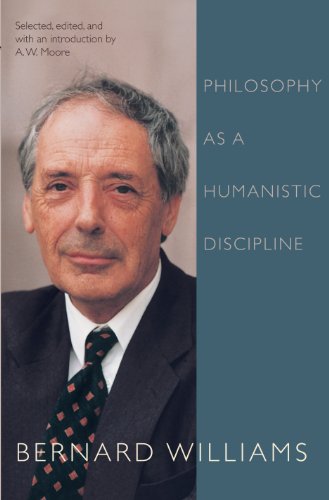
Philosophy as a Humanistic Discipline by Bernard Williams
What can - and what can't - philosophy do? What are its ethical risks - and its possible rewards? How does it differ from science? In "Philosophy as a Humanistic Discipline", Bernard Williams addresses these questions and presents a striking vision of philosophy as fundamentally different from science in its aims and methods even though there is still in philosophy "something that counts as getting it right." Written with his distinctive combination of rigor, imagination, depth, and humanism, the book amply demonstrates why Williams was one of the greatest philosophers of the twentieth century. Spanning his career from his first publication to one of his last lectures, the book's previously unpublished or uncollected essays address metaphysics, epistemology, and ethics, as well as the scope and limits of philosophy itself.The essays are unified by Williams' constant concern that philosophy maintain contact with the human problems that animate it in the first place. As the book's editor, A. W. Moore, writes in his introduction, the title essay is "a kind of manifesto for Williams' conception of his own life's work." It is where he most directly asks "what philosophy can and cannot contribute to the project of making sense of things" - answering that what philosophy can best help make sense of is "being human." "Philosophy as a Humanistic Discipline" is one of three posthumous books by Williams to be published by Princeton University Press. "In the Beginning Was the Deed: Realism and Moralism in Political Argument" was published in the fall of 2005. "The Sense of the Past: Essays in the History of Philosophy" is being published shortly after the present volume.
[Williams emphasized] the role of the local and the historical, the need for philosophy to 'sound right' One ends Philosophy as a Humanistic Discipline wishing that he had another decade both to do the sort of philosophy that 'sounds right' and to tell us more about what made it sound so. -- Alan Ryan New York Review of Books Editor A.W. Moore ... has certainly done the scholarly world a service... Williams is a virtuoso practitioner and questioner of philosophy. His task is both positive and negative: positive in that he seeks to carve out a place for distinctively philosophical contributions to human knowledge and well-being (where these contributions are indeed peculiarly philosophical and not scientific), and negative in that he is concerned with the limited nature of these contributions. Choice [Williams's books] reveal just how challenging, and how enjoyable, really imaginative philosophy can be. -- Simon Blackburn New Republic
Bernard Williams was Knightbridge Professor of Philosophy, Cambridge University (1967-1979), Monroe Deutsch Professor of Philosophy, University of California, Berkeley (1988-2003), and White's Professor of Moral Philosophy, Oxford University (1990-1996), and was a Fellow of All Souls College, Oxford until his death in 2003. A. W. Moore is Professor of Philosophy at Oxford and the author of "The Infinite, Points of View," and "Noble in Reason, Infinite in Faculty".
| SKU | Unavailable |
| ISBN 13 | 9780691124261 |
| ISBN 10 | 0691124264 |
| Title | Philosophy as a Humanistic Discipline |
| Author | Bernard Williams |
| Condition | Unavailable |
| Binding Type | Hardback |
| Publisher | Princeton University Press |
| Year published | 2006-01-22 |
| Number of pages | 264 |
| Cover note | Book picture is for illustrative purposes only, actual binding, cover or edition may vary. |
| Note | Unavailable |