
Plant Cells vs Animal Cells


World of Books
The feel-good place to buy books
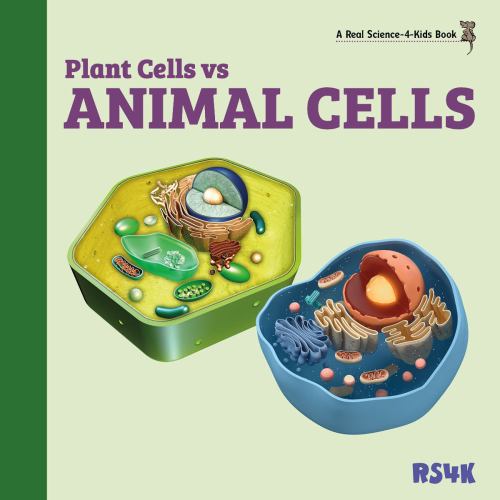
Plant Cells vs Animal Cells by Rebecca Woodbury M Ed Ph D
In the leveled reader Plant Cells vs Animal Cells, young readers discover that plants and animals have different types of cells. Cells are made of atoms and molecules and do different jobs in living things. Atoms and molecules are defined. Both plant cells and animal cells are surrounded by a cell membrane and have organelles, which are structures inside cells that do different jobs. The nucleus of a cell is the organelle where DNA is made and held. DNA is a strand of linked atoms that tell the cell what to do. A ribosome is an organelle that makes proteins, which are long chains of atoms. Proteins do all the work inside a cell, cutting, joining, and moving molecules. A mitochondrion is an organelle that makes energy for the cell. Plant and animal cells are also different. Plant cells have a stiff outer cell wall in addition to a cell membrane. Animals cells have only a cell membrane. Plant cells have chloroplasts, which are organelles that catch sunlight to make food. Animal cells do not have chloroplasts and do not make food from sunlight but get their food from eating other animals and plants. Fundamental science concepts in biology are explained through easily understood text and colorful illustrations and photographs. Cells, atoms, molecules, DNA, energy, force, and work are defined. A pronunciation guide of scientific terms is included. 24 pages. Reading Level 1-3, Interest Level 2-5. Lexile measure 520L. Word count 341.
Woodbury, Rebecca: - Dr. Rebecca Woodbury received her Ph.D. in biophysical chemistry from the University of New Mexico in 1992. She was awarded a National Science Foundation postdoctoral fellowship in the Department of Molecular Biology at the University of New Mexico, followed by a Burroughs Wellcome Fund Postdoctoral Fellowship in the Department of Molecular Biology at the University of California, Berkeley. While home schooling her three children, Dr. Woodbury was unable to find a curriculum that provided a solid foundation in science. She left academia, and using her scientific background coupled with her love of learning, she developed a series of science books for kids. The Real Science-4-Kids curriculum provides students with a solid foundation in science and gives them the tools to evaluate scientific data on their own. We should not rely on the 'experts' but instead learn how to critically evaluate every scientific claim, states Dr. Woodbury. In these uncertain times with so many social, scientific, and economic problems, it is not enough to teach our kids what to learn. We must also teach them how to learn, and we must encourage our kids to learn from others. Part of learning from others is to know how to engage in productive debate. The Real Science-4-Kids curriculum, with its engaging, kid-friendly Student Textbooks; Laboratory Notebooks full of real science experiments; and easy to use Teacher's Manuals, provides kids with a solid science education in chemistry, biology, physics, geology, and astronomy. This curriculum is used in all 50 states in the US and many other countries. Dr. Woodbury and her publishing team continue to develop and test new products, including leveled readers and mini books, at the Real Science-4-Kids Albuquerque headquarters.
| SKU | Unavailable |
| ISBN 13 | 9781950415717 |
| ISBN 10 | 1950415716 |
| Title | Plant Cells vs Animal Cells |
| Author | Rebecca Woodbury M Ed Ph D |
| Series | Real Science-4-Kids Ser |
| Condition | Unavailable |
| Binding Type | Paperback |
| Publisher | Real Science-4-Kids |
| Year published | 2020-06-26 |
| Number of pages | 26 |
| Cover note | Book picture is for illustrative purposes only, actual binding, cover or edition may vary. |
| Note | Unavailable |