


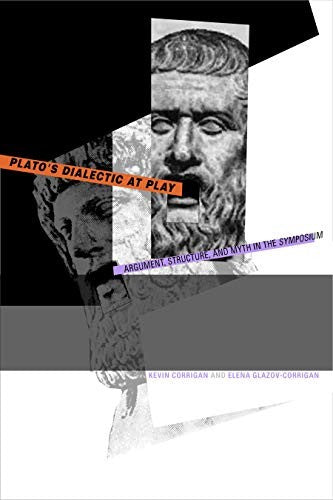
Plato's Dialectic at Play by Kevin Corrigan
By uncovering the structural design of the dialogue, The Symposium, this work aims at revealing a Plato for whom the dialogical form was not merely ornamentation or philosophical methodology, but the essence of philosophical exploration. His dialectic is not only argument; it is also play.“Its literary sensibility and systematic lucidity make this work a remarkable contribution to the debates concerning Plato’s Symposium as well as the vexata quaestio of the relation between poetry and philosophy or, more broadly, art, literature, imagination, and thinking”
—Claudia Baracchi, The New School
“Plato’s Dialectic at Play makes a significant and original contribution to the study of Plato in general and the Symposium in particular. It is stylish and erudite in its writing, theoretically sound, and textually precise. The goal of the book is twofold: to determine the structure of the Symposium as a whole and to ascertain the relationship between the dialogue’s explicit philosophical themes and its apparently nonphilosophical details. The analysis proceeds sequentially through each of the speeches in the Symposium, and the authors focus primarily upon ways in which this dialogue provides the attentive reader with principles for interpreting the text. This self-referentiality is enormously complex, and the authors simultaneously demonstrate this complexity and carve for the reader a path through this maze. The work demonstrates the power inherent in the familiar themes of the Symposium (especially the transformative character of the ascent to beauty) while also developing a new ‘Platonism’ according to which Plato is simultaneously a remarkable philosopher of art (contra familiar interpretations of the Republic, a work the authors argue is a companion piece to the Symposium) and an artistic innovator (earning the honor of being the first novelist). The scholarship is strong and well grounded in contemporary and classical sources and commentators. This reinterpretation and defense of the Platonic philosophy is very relevant to contemporary Plato studies (especially those influenced by contemporary Continental philosophy) while being quite refreshingly original. The book will be valuable to students of Plato in a wide variety of fields, especially philosophy, classics, literary studies, and political theory.”
—John Russon, University of Guelph
“Kevin Corrigan and Elena Glazov-Corrigan have teamed up to produce an original, elegantly written, and daring interpretation of the dialogue as a whole. . . . I found the book stimulating and enjoyable to read.”
—David Konstan Notre Dame Philosophical Reviews
“Plato’s Dialectic at Play is a wide-ranging, intelligent and energetic book whose complexity is a fine companion to the artful complexity of the Symposium itself. As such, it deserves careful reading (and rereading) by historians of philosophy, intellectual historians, and all those interested in the intersection of literature and philosophy.”
—William Desmond Hermathena
Kevin Corrigan is Professor in the Graduate Institute of Liberal Arts at Emory University.
Elena Glazov-Corrigan is Associate Professor and Chair of the Department of Russian and East Asian Languages and Cultures at Emory University.
| SKU | Unavailable |
| ISBN 13 | 9780271029139 |
| ISBN 10 | 0271029137 |
| Title | Plato's Dialectic at Play |
| Author | Kevin Corrigan |
| Condition | Unavailable |
| Binding Type | Paperback |
| Publisher | Pennsylvania State University Press |
| Year published | 2004-11-15 |
| Number of pages | 280 |
| Cover note | Book picture is for illustrative purposes only, actual binding, cover or edition may vary. |
| Note | Unavailable |