
Poetry and the Language of Oppression


Summary
The feel-good place to buy books
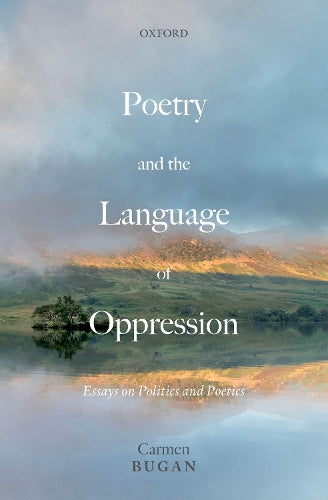
Poetry and the Language of Oppression by Carmen Bugan
A first-hand account of the creative process that engages with the language of oppression and with politics in our time. How does the poet become attuned to the language of the world's upheaval? How does one talk insightfully about suffering, without creating more of it? What is freedom in language and how does the poet who has endured political oppression write himself or herself free? What is literary testimony? Poetry and the Language of Oppression is a consideration of the creative process that rests on the conviction that poetry is of help in moments of public duress, providing an illumination of life and a healing language. Oppression, repression, expression, as well as their tools (prison, surveillance, gestures in language) have been with us in various forms throughout history, and this volume represents a particular aspect of these conditions of our humanity as they play out in our time, providing another instance of the communion, and sometimes confrontation, with the language that makes us human.
.. beautiful and intensely scrupulous ... Throughout the book, Bugan's own highly regarded poetry serves to distil the essence of her far-ranging political and cultural analysis and to re-enact it in verse that strikes close to home -- home that for her stricken family was a target of Nicolae Ceaulsescu's fascist regime. * George Kalogeris, Literary Matters *
... not just timely but necessary reading. "The essays provide an academic monograph on how poetry, a poet's voice and craft, can and should approach questions of politics and justice." * Rick Larios,, The Manhattan Review *
Poetry, in the title of Carmen Bugan's beautiful and intensely scrupulous book, at first glance positions itself forthrightly and steadfastly in opposition to the Language of Oppression. Yet the equally vigilant placing of and then of serves to remind us that Language can cut both ways: poetry as the transmutation of tyranny into verse and "poetry" as propaganda for the state. This kind of hyper-linguistic alertness comes second nature to Bugan's art. * George Kalogeris, author of Dialogos and of Camus: Carnets, Literary Matters *
...beautiful and intensely scrupulous... Throughout the book, Bugan's own highly regarded poetry serves to distill the essence of her far-ranging political and cultural analysis and to reenact it in verse that strikes close to home-home that for her stricken family was a target of Nicolae Ceaulsescu's fascist regime. * George Kalogeris, Literary Matters *
An inspired poet and contemplative analyst...The essays preserve much of their original engaging oral style, which enhances the authenticity of Bugan's self-analytical voice as a writer whose language reflects her personal encounter with history. They make a persuasive plea for viewing politics in literature 'beyond their use as mere partisanship', while transcending political one-sidedness towards 'reassessing how we govern ourselves with language' (pp. 148-9)... a poet's celebration of wisdom and wonder to trace back the nature and processes of our Lebenswelt ('life-world') ultimately to the mystery of language itself. * Alexandru Popescu, Balliol College Record *
...an extraordinary book...The poems reprinted here are in their different ways remarkable but nothing can beat "The Divorce" for its combination of emotional power and linguistic restraint. It's one of the most memorable modern poems of witness I have read... I find Bugan's analysis of the role played by poetry in her survival to be honest and truthful—and to achieve that is itself a kind of miracle. It has been the making of her... You can feel the extent to which the book is driven by a burden of responsibility towards other victims of oppression; as Seamus Heaney put it, she is driven by a feeling of "solidarity with the doomed". This is in every way a stunning volume by an utterly remarkable writer. * Duncan Wu, The Oxford Magazine *
Bugan's writing demonstrates her resilience and courage to nevertheless express herself when facing oppression. * Martha Stuit, Pulp *
In this powerful and personal book, Bugan brings up questions about literary testimony and the meaning of freedom in current times, while confronting the power of language. * Best Books for Writers, chosen by Poets & Writers *
These are books to purchase, mark up, and return to, one essay at a time...Bugan has so many smart things to say about poetry and politics that one exits the encounter not just illuminated but shocked * Lee Oser, ALSCW President, Literary Matters *
Poetry and the Language of Oppression probes the delicate interface between realities that bind and words that free. We follow Bugan from Communist Romania where she discovers the tensions of writing under political oppression, to the US, Britain, France, and back to the US, where she becomes an accomplished public voice speaking for poems as meeting places of hope and marvel in uncertain times. Like the poets from whom she draws strength, among them Czeslaw Milosz, Seamus Heaney, and Pablo Neruda, Bugan believes passionately that poets can contribute to history by telling the truth and speaking 'heart to heart' about political discontent. Poetry and the Language of Oppression testifies to the vital work that poetry does in our lives, by healing division and imagining new spaces of freedom. This is a deeply moving and convincing book. * Elleke Boehmer, Professor of World Literature in English, University of Oxford *
Bugan has written a deeply personal account of her travels across the languages of poetry and oppression. These two languages, she argues with admirable clarity, are not isolated from one another; they are often co-present, compelling us to come to terms with the fragility of poetry. Bugan's own poems scattered across the pages are a gift, as are her reflections on Whitman, Mandelstam, Milosz, Wole Soyinka, and so many others. * Galin Tihanov, George Steiner Professor of Comparative Literature , Queen Mary University of London *
... not just timely but necessary reading. "The essays provide an academic monograph on how poetry, a poet's voice and craft, can and should approach questions of politics and justice." * Rick Larios,, The Manhattan Review *
Poetry, in the title of Carmen Bugan's beautiful and intensely scrupulous book, at first glance positions itself forthrightly and steadfastly in opposition to the Language of Oppression. Yet the equally vigilant placing of and then of serves to remind us that Language can cut both ways: poetry as the transmutation of tyranny into verse and "poetry" as propaganda for the state. This kind of hyper-linguistic alertness comes second nature to Bugan's art. * George Kalogeris, author of Dialogos and of Camus: Carnets, Literary Matters *
...beautiful and intensely scrupulous... Throughout the book, Bugan's own highly regarded poetry serves to distill the essence of her far-ranging political and cultural analysis and to reenact it in verse that strikes close to home-home that for her stricken family was a target of Nicolae Ceaulsescu's fascist regime. * George Kalogeris, Literary Matters *
An inspired poet and contemplative analyst...The essays preserve much of their original engaging oral style, which enhances the authenticity of Bugan's self-analytical voice as a writer whose language reflects her personal encounter with history. They make a persuasive plea for viewing politics in literature 'beyond their use as mere partisanship', while transcending political one-sidedness towards 'reassessing how we govern ourselves with language' (pp. 148-9)... a poet's celebration of wisdom and wonder to trace back the nature and processes of our Lebenswelt ('life-world') ultimately to the mystery of language itself. * Alexandru Popescu, Balliol College Record *
...an extraordinary book...The poems reprinted here are in their different ways remarkable but nothing can beat "The Divorce" for its combination of emotional power and linguistic restraint. It's one of the most memorable modern poems of witness I have read... I find Bugan's analysis of the role played by poetry in her survival to be honest and truthful—and to achieve that is itself a kind of miracle. It has been the making of her... You can feel the extent to which the book is driven by a burden of responsibility towards other victims of oppression; as Seamus Heaney put it, she is driven by a feeling of "solidarity with the doomed". This is in every way a stunning volume by an utterly remarkable writer. * Duncan Wu, The Oxford Magazine *
Bugan's writing demonstrates her resilience and courage to nevertheless express herself when facing oppression. * Martha Stuit, Pulp *
In this powerful and personal book, Bugan brings up questions about literary testimony and the meaning of freedom in current times, while confronting the power of language. * Best Books for Writers, chosen by Poets & Writers *
These are books to purchase, mark up, and return to, one essay at a time...Bugan has so many smart things to say about poetry and politics that one exits the encounter not just illuminated but shocked * Lee Oser, ALSCW President, Literary Matters *
Poetry and the Language of Oppression probes the delicate interface between realities that bind and words that free. We follow Bugan from Communist Romania where she discovers the tensions of writing under political oppression, to the US, Britain, France, and back to the US, where she becomes an accomplished public voice speaking for poems as meeting places of hope and marvel in uncertain times. Like the poets from whom she draws strength, among them Czeslaw Milosz, Seamus Heaney, and Pablo Neruda, Bugan believes passionately that poets can contribute to history by telling the truth and speaking 'heart to heart' about political discontent. Poetry and the Language of Oppression testifies to the vital work that poetry does in our lives, by healing division and imagining new spaces of freedom. This is a deeply moving and convincing book. * Elleke Boehmer, Professor of World Literature in English, University of Oxford *
Bugan has written a deeply personal account of her travels across the languages of poetry and oppression. These two languages, she argues with admirable clarity, are not isolated from one another; they are often co-present, compelling us to come to terms with the fragility of poetry. Bugan's own poems scattered across the pages are a gift, as are her reflections on Whitman, Mandelstam, Milosz, Wole Soyinka, and so many others. * Galin Tihanov, George Steiner Professor of Comparative Literature , Queen Mary University of London *
Carmen Bugan, George Orwell Prize Fellow, is the author of four poetry collections, most recently Lilies from America: New and Selected Poems (a PBS Special Commendation), a memoir, Burying the Typewriter: Childhood Under the Eye of the Secret Police (a BBC Radio 4 Book of the Week) and a monograph on Seamus Heaney and East European Poetry in Translation: Poetics of Exile. She was the 2018 Helen DeRoy Professor in Honors at the University of Michigan, a Chargée de Cours at the Université de Fribourg in Switzerland, and taught in the Continuing Education department at the University of Oxford, while she was a Creative Arts Fellow in Literature at Wolfson College. She has a doctorate in English literature from Balliol College, Oxford. She currently teaches at the Gotham Writers' Workshop in Manhattan.
| SKU | Unavailable |
| ISBN 13 | 9780198868323 |
| ISBN 10 | 0198868324 |
| Title | Poetry and the Language of Oppression |
| Author | Carmen Bugan |
| Condition | Unavailable |
| Publisher | Oxford University Press |
| Year published | 2021-06-17 |
| Number of pages | 224 |
| Cover note | Book picture is for illustrative purposes only, actual binding, cover or edition may vary. |
| Note | Unavailable |