


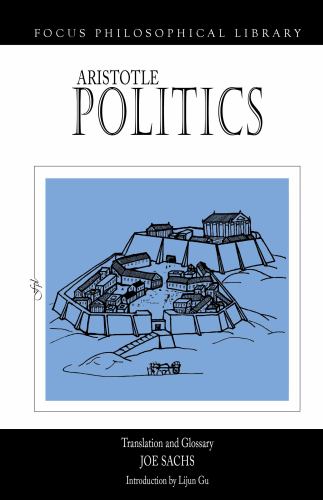
Politics by Aristotle
Aristotle's life was primarily that of a scholar. However, like the other ancient philosophers, it was not the stereotypical ivory tower existence. His father was court physician to Amyntas I of Macedon, so Aristotle grew up in a royal household. Aristotle also knew Philip of Macedon (son of Amyntas I) and there is a tradition that says Aristotle tutored Philip's son Alexander, who would later be called the Great after expanding the Macedonian Empire all the way to what is now India. Clearly, Aristotle had significant firsthand experience with politics, though scholars disagree about how much influence, if any, this experience had on Aristotle's thought. There is certainly no evidence that Alexander's subsequent career was much influenced by Aristotle's teaching, which is uniformly critical of war and conquest as goals for human beings and which praises the intellectual, contemplative lifestyle. It is noteworthy that although Aristotle praises the politically active life, he spent most of his own life in Athens, where he was not a citizen and would not have been allowed to participate directly in politics. Aristotle studied under Plato at Plato's Academy in Athens, and eventually opened a school of his own (the Lyceum) there. As a scholar, Aristotle had a wide range of interests. He wrote about meteorology, biology, physics, poetry, logic, rhetoric, and politics and ethics, among other subjects. His writings on many of these interests remained definitive for almost two millennia. They remained, and remain, so valuable in part because of the comprehensiveness of his efforts. For example, in order to understand political phenomena, he had his students collect information on the political organization and history of 158 different cities. The Politics makes frequent reference to political events and institutions from many of these cities, drawing on his students' research. Aristotle's theories about the best ethical and political life are drawn from substantial amounts of empirical research. (The Internet Encyclopedia of Philosophy)
ARISTOTLE was born in the northern Greek town of Stagira in 384 B.C.E., where his father was the personal physician to the great-grandfather of Alexander the Great. At the age of eighteen Aristotle entered Plato's Academy and soon became recognized as its most important student. He remained under Plato's tutelage for nearly twenty years. After his teacher's death in 347 B.C.E., Aristotle cultivated associations with other Academy students throughout Greece and Asia Minor. Then in 342 B.C.E., Aristotle was asked by King Philip II of Macedonia to become the tutor for his young son Alexander, who was later to become the conqueror of much of the known world at that time. The young prince remained under Aristotle's supervision until 336 B.C.E., when he acceded to the throne after his father's death. Two years later Aristotle returned to Athens and founded his own school, which he called the Lyceum. This intellectual center flourished during the years when Alexander the Great ruled Greece as part of his large empire. But upon Alexander's death in 323 B.C.E., Aristotle was charged with impiety by Athenians who resented his associations with the Macedonian conqueror. Rather than risk the same fate as Plato's mentor, Socrates, Aristotle fled to the city of Chalcis, where he died in 322 B.C.E. Aristotle's interests, like those of Plato, were diverse and his writing cast its shadow on many fields, including logic, metaphysics, epistemology, ethics, politics, and the sciences. Among his most well-known works are: The Categories, The Prior and Posterior Analytics, The Physics, The Meta-physics, De Anima, The Nicomachean Ethics, and The Politics.
| SKU | Unavailable |
| ISBN 13 | 9781585103768 |
| ISBN 10 | 1585103764 |
| Title | Politics |
| Author | Aristotle |
| Series | Focus Philosophical Library |
| Condition | Unavailable |
| Binding Type | Paperback |
| Publisher | Focus Publishing/R Pullins & Co |
| Year published | 2012-08-10 |
| Number of pages | 336 |
| Cover note | Book picture is for illustrative purposes only, actual binding, cover or edition may vary. |
| Note | Unavailable |