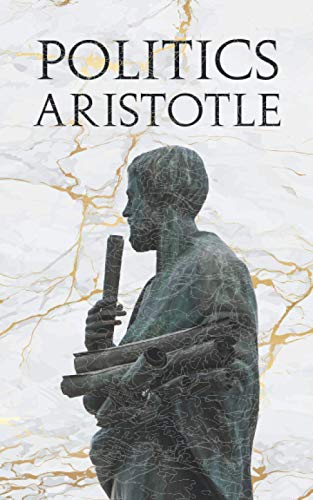
Politics by Aristotle

Politics by Aristotle

Regular price
Checking stock...
Regular price
Checking stock...
World of Books

At World of Books, you’ll find millions of preloved reads at great prices, from bestsellers to hidden gems. Every book you buy saves money and helps reduce waste, so you can read more for less while giving stories a second life.

The feel-good place to buy books
  • Free US shipping over $15
  • Buying preloved emits 41% less CO2 than new
  • Millions of affordable books
  • Give your books a new home - sell them back to us!

Politics by Aristotle

Similar to Nicomachean Ethics, Aristotle explores another facet of good living by outlining the best governing practices that benefit the majority, and not the minority. In The Politics, he defines various institutions and how they should operate within an established system.

The Politics provides an analysis of contemporary government as it relates to all people. Aristotle discusses the positive and negative qualities of authority and how they affect civilian life. In eight books, he details the tenets of the political community, including justice, the economy and household management. He recounts the actions of previous administrations, highlighting the differences between a democracy and oligarchy. He also examines the purpose of constitutions and how they can better serve the state.

By studying the past, politicians can navigate and overcome challenges that toppled previous regimes. The Politics contains a strategic framework that can be used in a modern-day context. It offers a comprehensive look at the people and processes expected to maintain law, order and prosperity.

With an eye-catching new cover, and professionally typeset manuscript, this edition of The Politics is both modern and readable.

ARISTOTLE was born in the northern Greek town of Stagira in 384 B.C.E., where his father was the personal physician to the great-grandfather of Alexander the Great. At the age of eighteen Aristotle entered Plato's Academy and soon became recognized as its most important student. He remained under Plato's tutelage for nearly twenty years.

After his teacher's death in 347 B.C.E., Aristotle cultivated associations with other Academy students throughout Greece and Asia Minor. Then in 342 B.C.E., Aristotle was asked by King Philip II of Macedonia to become the tutor for his young son Alexander, who was later to become the conqueror of much of the known world at that time. The young prince remained under Aristotle's supervision until 336 B.C.E., when he acceded to the throne after his father's death. Two years later Aristotle returned to Athens and founded his own school, which he called the Lyceum. This intellectual center flourished during the years when Alexander the Great ruled Greece as part of his large empire. But upon Alexander's death in 323 B.C.E., Aristotle was charged with impiety by Athenians who resented his associations with the Macedonian conqueror. Rather than risk the same fate as Plato's mentor, Socrates, Aristotle fled to the city of Chalcis, where he died in 322 B.C.E.

Aristotle's interests, like those of Plato, were diverse and his writing cast its shadow on many fields, including logic, metaphysics, epistemology, ethics, politics, and the sciences. Among his most well-known works are: The Categories, The Prior and Posterior Analytics, The Physics, The Meta-physics, De Anima, The Nicomachean Ethics, and The Politics.

SKU Unavailable
ISBN 13 9781774261071
ISBN 10 1774261073
Title Politics
Author Aristotle
Condition Unavailable
Binding Type Paperback
Publisher East India Publishing Company
Year published 2021-01-01
Number of pages 248
Cover note Book picture is for illustrative purposes only, actual binding, cover or edition may vary.