
The Principles of Political Economy and Taxation


Summary
The feel-good place to buy books
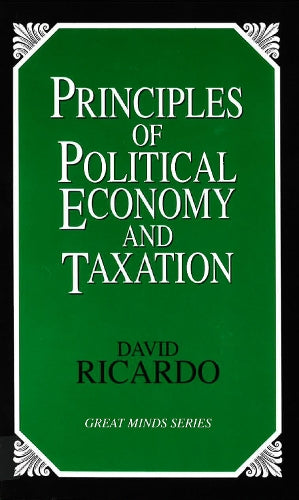
The Principles of Political Economy and Taxation by David Ricardo
David Ricardo (1772-1823), the founder of the classical school of economics, applied the deductive logic of the philosopher James Mill to the analysis of monetary principles. His chief work, Principles of Political Economy and Taxation, first published in 1817, had a profound impact and remains one of the groundworks of modern economics. Ricardo's labor theory of value, as well as his elaboration of the division of incomes, and the function of wages, rent, and trade, deeply influenced the economic philosophies of Karl Marx, John Stuart Mill, Alfred Marshall, and many others.
David Ricardo (1772-1823) was a British political economist, born in London. Ricardo was a political contemporary of Thomas Malthus, James Mill, and Adam Smith, with the latter's The Wealth of Nations serving as a chief inspiration for his economic studies. Ricardo's legacy is the Value Theory, which he details in his book, Principles of Political Economy and Taxation. Other well-known works by Ricardo are The High Price of Bullion, a Proof of the Depreciation of Bank Notes and Essay on the Influence of a Low Price of Corn on the Profits of Stock.
| SKU | Unavailable |
| ISBN 13 | 9781573921091 |
| ISBN 10 | 1573921092 |
| Title | The Principles of Political Economy and Taxation |
| Author | David Ricardo |
| Series | Great Minds Series |
| Condition | Unavailable |
| Binding Type | Paperback |
| Publisher | Prometheus Books |
| Year published | 1996-11-01 |
| Number of pages | 305 |
| Cover note | Book picture is for illustrative purposes only, actual binding, cover or edition may vary. |
| Note | Unavailable |