
Principles of Terrestrial Ecosystem Ecology


Summary
The feel-good place to buy books
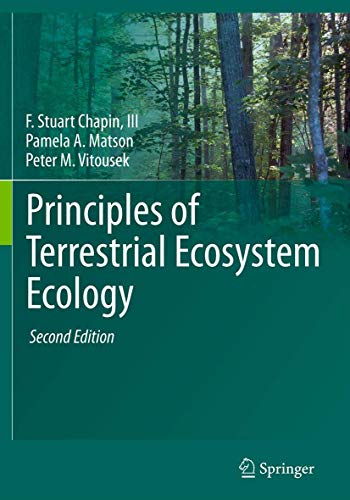
Principles of Terrestrial Ecosystem Ecology by F Stuart Chapin Iii
The ecosystem approach to ecology treats organisms and the physical elements of their environment as components of a single, integrated system. This comprehensive textbook outlines the central processes that characterize terrestrial ecosystems, tracing the flow of water, carbon, and nutrients from their abiotic origins to their cycles through plants, animals, and decomposer organisms. As human activity becomes an increasingly dominant factor in natural processes around the globe, landscape dynamics over time and space have become the focus of recent attention. This book synthesizes current advances in ecology with established theory to offer a complete survey of ecosystem pattern and process in the terrestrial environment. Featuring review questions at the end of each chapter, suggestions for recommended reading, and a glossary of ecological terms, Principles of Terrestrial Ecosystem Ecology will be an important text suitable for use in all courses on ecosystem ecology. Resource managers, land use managers, and researchers will also welcome its thorough presentation of ecosystem essentials. About the Authors F. Stuart Chapin, I is Professor of Ecology at the Institute for Arctic Biology, University of Alaska at Fairbanks. Pamela Matson is Professor in the Department of Geological and Environmental Sciences and the Institute of International Studies, Stanford University; Director of the Earth Systems Degree Program and co-director of the Center for Environmental Science and Policy, Stanford University; and currently serves as president of the Ecological Society of America. Harold A. Mooney is Professor of Environmental Biology at Stanford University.Reviews of the first edition:
"This textbook includes 16 chapters, each ending with a summary, review questions and references to additional readings… It is especially characterized by the great importance (250 pp.) which is attributed to abiotic aspects of ecosystem ecology and to production processes as well as nutrient cycling … . All these chapters are structured in an excellent and well organized way. … Altogether, the authors have well succeeded in writing a comprehensive textbook, mainly for graduate students." (Angelika Schwabe, Phytocoenologia, Vol. 34 (3), 2004)
"This comprehensive textbook outlines the central processes that characterize terrestrial ecosystems, tracing the flow of water, carbon, and nutrients from their abiotic origins to their cycles through plants, animals, and decomposer organisms. … This book synthesizes current advances in ecology with established theory to offer a complete survey of ecosystem pattern and process in the terrestrial environment. … suitable for use in all courses on ecosystem ecology. Resource managers, land use managers, and researchers will also welcome its thorough presentation of ecosystem essentials." (Ethology, Ecology & Evolution, Vol. 15 (4), 2003)
From the reviews of the second edition:
“An outstanding textbook which, after definitions, sets the stage with primers on Earth’s climate system and geological processes. What follows is a magisterial and comprehensive account of the movements of water, energy, carbon and nutrients though natural systems. … authors delve into the finer detail and explain how biological processes can have important modulating effects through space and time. … The book is well written throughout and punctuated with excellent colour illustrations; no-one from undergraduates to established researchers can fail to learn something from it.” (Frontiers of Biogeography, Vol. 3 (3), 2011)
| SKU | Unavailable |
| ISBN 13 | 9781441995025 |
| ISBN 10 | 1441995021 |
| Title | Principles of Terrestrial Ecosystem Ecology |
| Author | F Stuart Chapin Iii |
| Condition | Unavailable |
| Binding Type | Paperback |
| Publisher | Springer-Verlag New York Inc. |
| Year published | 2011-09-01 |
| Number of pages | 529 |
| Cover note | Book picture is for illustrative purposes only, actual binding, cover or edition may vary. |
| Note | Unavailable |