


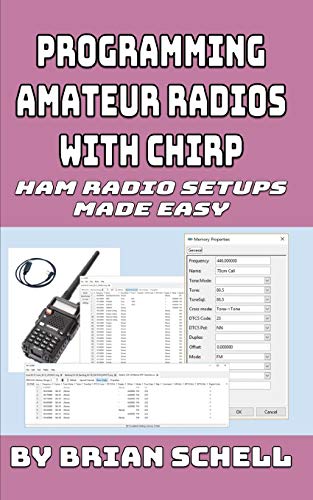
Programming Amateur Radios with CHIRP by Brian Schell
Back in my day, radios came with a CW key and a frequency knob, and that was all we needed. -Every Old Ham CurmudgeonOK, that's probably a slight exaggeration, but radios were a lot simpler in the distant past, when everything was station-to-station, and most communications were some flavor of HF. Nowadays, we have HF, VHF, UHF, digital modes, CW/SSB/AM/FM/MW, repeaters with offsets, repeaters with tones, User IDs, reflectors, talk groups, and who-knows-what coming down the road for next year. There are a lot of modes, tones, offsets, and little nit-picky details that have to go into our radios before we can even make a call.On the other hand, radios, especially handheld models, continue to get smaller, lighter, and generally have fewer physical buttons and controls. This is good in that it keeps costs down, adds to durability, and allows for waterproofing, but it doesn't make programming them any easier. Fortunately, we have computers to handle all the programming stuff for us. Just hook the radio up to the computer, enter in all your information, transfer the frequency and channel data into the radio, and you're good to go. Sounds simple, doesn't it?The problem is that radio manufacturers aren't necessarily good software designers. God forbid you try to program a radio on an Apple or Linux computer using manufacturer's software. None of the companies that make radios include software for these two very common operating systems. None. Even Windows users aren't in the clear. What happens when you try to use the software that came with your radio, when the radio was sold in 2007 and the software was made for Windows XP? Or maybe your radio came with a state-of-the-art serial port connector. That was great... back when all computers had serial ports; now, those are hard-to-find options or require an adaptor. And even though many ham operators enjoy tinkering with computers, there are many who still haven't embraced computers. These things just aren't that simple. Fortunately, there is CHIRP, a free, multi-platform software that works with a large number of common amateur radios. CHIRP even has database tools for setting up local repeaters, National Calling frequencies, MURS, FRS, GMRS, and Marine frequencies- you may not even need to look anything up If you're already comfortable with using programming software from RT Systems, or have no trouble working with whatever software that came with your radio, then maybe this book isn't for you. If you aren't good with computers, or you're having trouble with the basic process, don't know what all those columns mean, or are otherwise pulling your hair out trying to get your radio programmed, then this book is for you We'll walk through getting the software installed and set up, connecting your radio with an appropriate cable and communications port, reading template data from the radio, editing that data, and writing that data back out to the radio.


Brian Schell is a former College IT Instructor who has an extensive background in computer science dating back to the 1980s. He's authored over 20 books, with topics ranging from computers, to world religions, to ham radio, and even releases the occasional short horror tale.
| SKU | Unavailable |
| ISBN 13 | 9781720767268 |
| ISBN 10 | 1720767262 |
| Title | Programming Amateur Radios with CHIRP |
| Author | Brian Schell |
| Series | Amateur Radio For Beginners |
| Condition | Unavailable |
| Binding Type | Paperback |
| Publisher | Createspace Independent Publishing Platform |
| Year published | 2018-06-04 |
| Number of pages | 80 |
| Cover note | Book picture is for illustrative purposes only, actual binding, cover or edition may vary. |
| Note | Unavailable |