


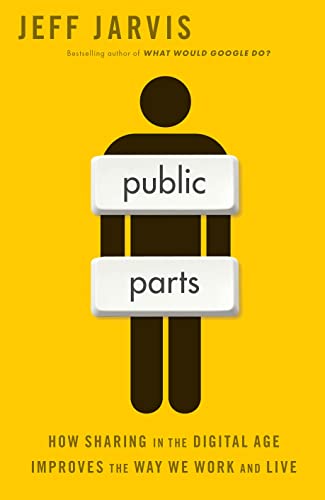
Public Parts by Jeff Jarvis
In Public Parts, Jeff Jarvis travels through history to show the amazing parallels of distrust and fear that met the advent of innovations such as the printing press and the camera. He reveals amazing, almost unnerving, connections between our suspicions and discomforts through history as technology has inexorably changed the world and our sense of us within it. Based on extensive interviews, Jarvis introduces us to the men and women building the Internet today. Some of them have become household names-Facebook's Mark Zuckerberg and Twitter's Ev Williams- many more of them may soon be recognized as the industrialists, philosophers, and designers of our online future. He reveals the promising ways in which the Internet is already allowing us to collaborate, organize and create in dazzling ways-how we manufacture and merchandise, buy and sell, teach and learn. It is a world being built on an ethic of transparency and generosity but as Jarvis shows, it is a world that's already impacting economies, industries, human health, and many other facets of humanity in meaningful and measurable ways. Jarvis makes an urgent case that the future of the internet-needs as much protection as the physical space we share. It is a space of the public, for the public and by the public-and it needs respect and protection from all of us, no matter how we use it.
“A refreshing take on a topic often covered by people who feel that the Internet…threatens to imperil our children and undermine our society”—Jessi Hempel, Forbes.com
"This is a superior work. Not only is it well researched and elegantly argued but he makes some original observations about how digital technology is changing the nature of human self-expression."—John Gapper, The Financial Times
"Jarvis offers a persuasive and personal look at why sharing things publicly on the Web should become the norm... Jarvis works methodically in Public Parts to unravel long-held beliefs about why openness online is dangerous... Jarvis' message of openness will be provocative to many, but what he explores is only the beginning of a revolution that will continue to change how we use the Web—and how the Web uses us."—Mark W. Smith, Detroit Free Press
"The author of What Would Google Do? returns with another thoughtful look at the Internet age. A welcome and well-reasoned counterpoint to the arguments that social-networking sites and the easy availability of personal information online are undermining our society and putting our safety at risk... A must-read for anyone interested in the issue of connectivity versus privacy."—David Pitt, Booklist
"It's important and will become more so, and I'm very glad Jeff has written his valuable book."—Stephen Baker, author of The Numerati
"How do we define what is public and what is private? What are the benefits and dangers of living a life in which everything is shared? Jarvis explores these questions and more in his immensely readable, chatty style... No one knows what's going to happen next. But people like Jarvis are having fun making sense of these confusing early years."—Niall Firth, New Scientist
"Jarvis makes a powerful case for re-framing the way we think about privacy, and for better appreciating the benefits of “publicness” in the information age."—Adam Thierer, Forbes.com
"This is a superior work. Not only is it well researched and elegantly argued but he makes some original observations about how digital technology is changing the nature of human self-expression."—John Gapper, The Financial Times
"Jarvis offers a persuasive and personal look at why sharing things publicly on the Web should become the norm... Jarvis works methodically in Public Parts to unravel long-held beliefs about why openness online is dangerous... Jarvis' message of openness will be provocative to many, but what he explores is only the beginning of a revolution that will continue to change how we use the Web—and how the Web uses us."—Mark W. Smith, Detroit Free Press
"The author of What Would Google Do? returns with another thoughtful look at the Internet age. A welcome and well-reasoned counterpoint to the arguments that social-networking sites and the easy availability of personal information online are undermining our society and putting our safety at risk... A must-read for anyone interested in the issue of connectivity versus privacy."—David Pitt, Booklist
"It's important and will become more so, and I'm very glad Jeff has written his valuable book."—Stephen Baker, author of The Numerati
"How do we define what is public and what is private? What are the benefits and dangers of living a life in which everything is shared? Jarvis explores these questions and more in his immensely readable, chatty style... No one knows what's going to happen next. But people like Jarvis are having fun making sense of these confusing early years."—Niall Firth, New Scientist
"Jarvis makes a powerful case for re-framing the way we think about privacy, and for better appreciating the benefits of “publicness” in the information age."—Adam Thierer, Forbes.com
Jeff Jarvis blogs about media, news, technology, and business at Buzzmachine.com. He is associate professor and director of the Tow-Knight Center for Entrepreneurial Journalism at the City University of New York’s Graduate School of Journalism, and lives in the New York area.
| SKU | Unavailable |
| ISBN 13 | 9781451636000 |
| ISBN 10 | 1451636008 |
| Title | Public Parts |
| Author | Jeff Jarvis |
| Condition | Unavailable |
| Binding Type | Hardback |
| Publisher | Simon & Schuster |
| Year published | 2011-09-29 |
| Number of pages | 272 |
| Cover note | Book picture is for illustrative purposes only, actual binding, cover or edition may vary. |
| Note | Unavailable |