
Public Space Design and Social Cohesion


Summary
The feel-good place to buy books
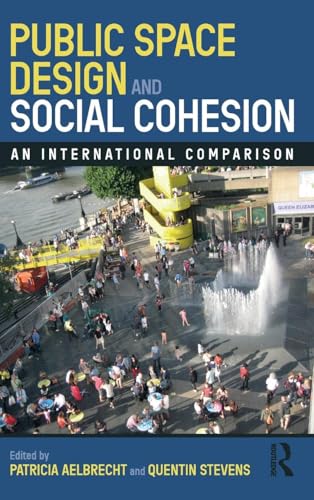
Public Space Design and Social Cohesion by Patricia Aelbrecht
Social cohesion is often perceived as being under threat from the increasing cultural and economic differences in contemporary cities and the increasing intensity of urban life. Public space, in its role as the main stage for social interactions between strangers, clearly plays a role in facilitating or limiting opportunities for social cohesion. But what exactly is social cohesion, how is it experienced in the public realm, and what role can the design of city spaces have in supporting or promoting it? There are significant knowledge gaps between the social sciences and design disciplines and between academia and practice, and thus a dispersed knowledge base that currently lacks nuanced insight into how urban design contributes to social integration or segregation. This book brings together scholarly knowledge at the intersection of public space design and social cohesion. It is based on original scholarly research and a depth of urban design practice, and analyses case studies from a variety of cities and cultures across the Global North and Global South. Its interdisciplinary, cross-cultural analysis will be of interest to academics, students, policymakers and practitioners engaged with a range of subject areas, including urban design, urban planning, architecture, landscape, cultural studies, human geography, social policy, sociology and anthropology. It will also have significant appeal to a wider non-academic readership, given its topical subject matter."Rather than living in segregated, inward-looking communities this innovative collection illuminates the role of public space design in promoting social cohesion and inclusion globallyBy examining bottom-up and engaged urban design projects the editors have brought together compelling empirical examples written by well-known researchers and design professionals working in the United States, Europe, Southeast Asia and Latin America that illustrate the strength and complexity of this relationship. The chapters focus on neighborhoods, housing estates, squares and streets where conflicts and solidarity are played out, and emphasize the spatiality of social cohesion as well as the cultural context of public spaces in people’s everyday lives. It provides a first look at what is happening internationally in terms of how urban design practice and local activism is taking back public space into their diverse lives, and in the process creating a more solid grounding for social relations, belonging and recognition of the other."
Setha Low, Professor of Environmental Psychology and Director of the Public Space Research Center, The Graduate Center, City University of New York
"This book is a valuable contribution to public space scholarship, bringing together a collection of comparative case studies from around the world that investigate whether and how public spaces can have a positive role in the perennial and contested search for social cohesion in diverse, stratified and fragmented urban societies."
Professor Ali Madanipour, School of Architecture, Planning and Landscape, Newcastle University, UK
Patricia Aelbrecht is Lecturer in Urban Design at the School of Geography and Planning, Cardiff University, UK. Her research focuses on the social dimension of urban design, in particular on how social practices and activism in public space shape and redefine the meanings and uses of public spaces in a wide range of cultural and social contexts in Europe. Recent work also investigates mega-events as catalysts of urban regeneration and the contested regeneration of post-war modernist cityscapes. She holds a PhD in Urban Studies and an MSc in International Planning from University College London, and a BArch and MArch from the Technical University of Lisbon, Portugal.
Quentin Stevens is Associate Professor in the School of Architecture and Design at RMIT University in Melbourne, Australia. He is author of The Ludic City, joint editor of Loose Space: Possibility and Diversity in Urban Life (both Routledge 2007), and author or editor of four other books with Routledge. His research focuses on environment-behaviour relations in public spaces; his recent projects have investigated social engagement around public memorials, public artworks, and urban waterfronts. He holds a PhD in Urban Design and a BArch from the University of Melbourne, and a Master’s in Urban Planning and Policy from the University of Illinois at Chicago, USA.
| SKU | Unavailable |
| ISBN 13 | 9781138594029 |
| ISBN 10 | 1138594024 |
| Title | Public Space Design and Social Cohesion |
| Author | Patricia Aelbrecht |
| Condition | Unavailable |
| Binding Type | Hardback |
| Publisher | Routledge |
| Year published | 2019-02-13 |
| Number of pages | 356 |
| Cover note | Book picture is for illustrative purposes only, actual binding, cover or edition may vary. |
| Note | Unavailable |