


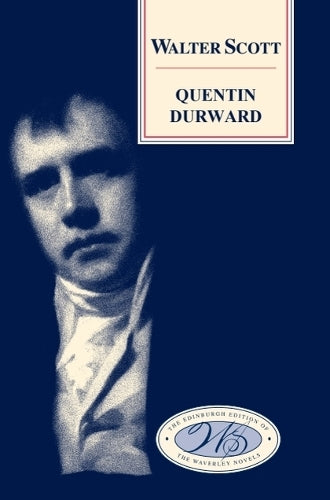
Quentin Durward by Walter Scott
Find Out What Scott Really WroteGoing back to the original manuscripts, a team of scholars has uncovered what Scott originally wrote and intended his public to read before errors, misreadings and expurgations crept in during production. Quentin Durward is a young Scotsman seeking fame and fortune in the France of Louis XI in the fifteenth century. He knows little and understands less, but Scott represents his ignorance and naivet as useful to 'the most sagacious prince in Europe' who needs servants motivated solely by the desire for coin and credit and lacking any interest in France which would interfere with the execution of his political aims. In Quentin Durward Scott studies the first modern state in the process of destroying the European feudal system.By far the most important of Scott's sources for Quentin Durward is the splendid Memoirs of Philippe de Comines. Comines, who has more than a walk-on role in the novel itself, was trusted councillor of Charles the Bold of Burgundy until 1472, when
Willl certainly be the definitive scholarly edition of Scott for the foreseeable futureThe notes and emendation lists ! evince years of thorough, diligent research into manuscripts, editions, sources, references, and allusions. The information will give the serious reader inestimable help in understanding Scott. Alexander and Wood give us a Quentin Durward that corresponds to no previous version of the novel. It is a social text for our moment in time which, given the publication history of the Waverley Novels, is eminently appropriate. This is the fifth volume of the EEWN to be edited by J. H. Alexander. In each the scholarly apparatus has been superb, and this edition of Quentin Durward is no exception, The Explanatory Notes, Historical Notes, Glossary, Map and Essay on the Text make this an indispensable work. For the study of Scott's first fictional foray on to the European continent. The Edinburgh Edition respects Scott the artist by 'restoring' versions of the novels that are not quite what his first readers saw. Indeed, it returns to manuscripts that the printers never handled, as Scott's fiction before 1827 was transcribed before it reached the printshop. Each volume of the Edinburgh edition presents an uncluttered text of one work, followed by an Essay on the Text by the editor of the work, a list of the emendations that have been made to the first edition, explanatory notes and a glossary ! The editorial essays are histories of the respective texts. Some of them are almost 100 pages long; when they are put together they constitute a fascinating and lucid account of Scott's methods of compostion and his financial manoeuvres. This edition is for anyone who takes Scott seriously. Willl certainly be the definitive scholarly edition of Scott for the foreseeable future. The notes and emendation lists ! evince years of thorough, diligent research into manuscripts, editions, sources, references, and allusions. The information will give the serious reader inestimable help in understanding Scott. Alexander and Wood give us a Quentin Durward that corresponds to no previous version of the novel. It is a social text for our moment in time which, given the publication history of the Waverley Novels, is eminently appropriate. This is the fifth volume of the EEWN to be edited by J. H. Alexander. In each the scholarly apparatus has been superb, and this edition of Quentin Durward is no exception, The Explanatory Notes, Historical Notes, Glossary, Map and Essay on the Text make this an indispensable work. For the study of Scott's first fictional foray on to the European continent. The Edinburgh Edition respects Scott the artist by 'restoring' versions of the novels that are not quite what his first readers saw. Indeed, it returns to manuscripts that the printers never handled, as Scott's fiction before 1827 was transcribed before it reached the printshop. Each volume of the Edinburgh edition presents an uncluttered text of one work, followed by an Essay on the Text by the editor of the work, a list of the emendations that have been made to the first edition, explanatory notes and a glossary ! The editorial essays are histories of the respective texts. Some of them are almost 100 pages long; when they are put together they constitute a fascinating and lucid account of Scott's methods of compostion and his financial manoeuvres. This edition is for anyone who takes Scott seriously.
Sir Walter Scott, was a Scottish historical novelist, playwright and poet. Many of his works remain classics and include Ivanhoe, Rob Roy, Waverley, The Heart of Midlothian and The Bride of Lammermoor. J. H. Alexander is Reader Emeritus in English at the University of Aberdeen. G A M Wood was formerly Senior Lecturer in English at the University of Stirling.
| SKU | Unavailable |
| ISBN 13 | 9780748605798 |
| ISBN 10 | 0748605797 |
| Title | Quentin Durward |
| Author | Sir Walter Scott |
| Series | Edinburgh Edition Of The Waverley Novels |
| Condition | Unavailable |
| Binding Type | Hardback |
| Publisher | Edinburgh University Press |
| Year published | 2001-04-10 |
| Number of pages | 595 |
| Cover note | Book picture is for illustrative purposes only, actual binding, cover or edition may vary. |
| Note | Unavailable |