


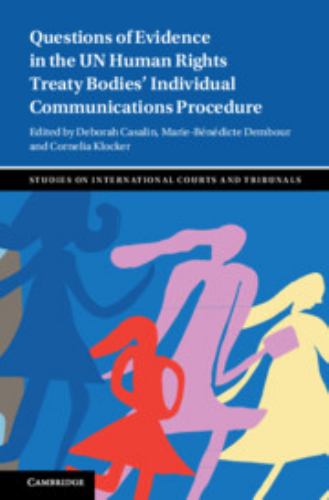
Questions of Evidence in the UN Human Rights Treaty Bodies' Individual Communications Procedure by Deborah Casalin
Eight United Nations human rights treaty bodies (UNTBs) can currently examine 'communications' (complaints) from individuals against states. This edited collection is the first in-depth analysis of the evidentiary regimes developed within this procedure. Nine case studies underscore the weak evidentiary basis of the UNTB decisions and the importance of addressing this issue, while the final chapter offers a set of practical recommendations. Grounded in academic research and legal practice, the volume incorporates doctrinal, critical, socio-legal, and anthropological perspectives. It provides an authoritative reference on UNTBs, whilst aiming at contributing to the strengthening of their evidentiary norms and practices. The title is also available open access on Cambridge Core.
'By drawing attention to the crucial role of evidence before United Nations human rights mechanisms, this volume of insightful essays allows readers to look with fresh eyes at a much-neglected aspect of international human rights lawThe collaboration of scholars, litigators and members of some of these mechanisms results in thoughtful evidence-based analyses from a variety of disciplinary perspectives. This welcome work provides fertile ground not only for deepening critical reflection on, but also for enhancing the legitimacy and efficiency of international human rights law.' Frans Viljoen, Professor of International Human Rights Law, University of Pretoria
'As a former Chair of the Chairs of the ten UN treaty bodies, I trust this timely and precious volume will give an added impetus to the treaty body harmonisation process. Coming at a time of resource constraints and reforms, it will help bring the treaty bodies closer together to hone their evidentiary regimes and deliver accessible, affordable, accountable, adaptable and quality justice and remedies to all.' Hilary Gbedemah, Rector, Law Institute (Ghana); CEDAW member (2013–2024); Chair of Chairs (2019–2020 )
'As a former Chair of the Chairs of the ten UN treaty bodies, I trust this timely and precious volume will give an added impetus to the treaty body harmonisation process. Coming at a time of resource constraints and reforms, it will help bring the treaty bodies closer together to hone their evidentiary regimes and deliver accessible, affordable, accountable, adaptable and quality justice and remedies to all.' Hilary Gbedemah, Rector, Law Institute (Ghana); CEDAW member (2013–2024); Chair of Chairs (2019–2020 )
Deborah Casalin is principal research fellow at the Law and Development Research Group at the University of Antwerp. Her doctoral research examined the role of the UN treaty bodies in ensuring reparation for arbitrary displacement, employing systematic case law analysis and a study of CESCR's decisions on mortgage evictions in Spain. Marie-Bénédicte Dembour is Professor of Law and Anthropology at Ghent University, where she leads the research project 'DISSECT: Evidence in International Human Rights Adjudication' (ERC-AdG-2018-834044). Her numerous publications include a special issue on 'The Evidentiary System of the European Court of Human Rights in Critical Perspective' (2023). Cornelia Klocker is a Senior Researcher at the Human Rights Centre, Faculty of Law and Criminology of Ghent University, Belgium. Her research centres on questions of non-discrimination and the intersections between human rights law and the law of armed conflict, including related evidentiary issues.
| SKU | Unavailable |
| ISBN 13 | 9781009639217 |
| ISBN 10 | 1009639218 |
| Title | Questions of Evidence in the UN Human Rights Treaty Bodies' Individual Communications Procedure |
| Author | Deborah Casalin |
| Series | Studies On International Courts And Tribunals |
| Condition | Unavailable |
| Binding Type | Paperback |
| Publisher | Cambridge University Press |
| Year published | 2026-05-31 |
| Number of pages | 285 |
| Cover note | Book picture is for illustrative purposes only, actual binding, cover or edition may vary. |
| Note | Unavailable |