


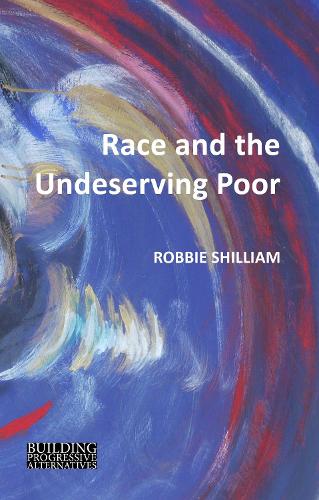
Race and the Undeserving Poor by Robbie Shilliam
A major new work that charts the historical development of a postcolonial settlement that has given rise to a racialized distintion between the deserving and undeserving poor, the latest incarnation of which is a distinction between a deserving, neglected white working class and others who are undeserving, not indigenous, and not white.
Politically uncertain times require rigorous and judicious scholarship and, with this superbly argued book, Robbie Shilliam provides just thatThe UK’s vote to leave the European Union has prompted a reconsideration of ideas of (national) belonging and of class. Shilliam eviscerates standard accounts that seek to locate the emergence of the ‘white working class’ in national terms and presents a brilliantly compelling account of why this emergence is better understood in terms of the postcolonial genealogy of British Empire. A vital, necessary book to make sense of our present. -- Gurminder K. Bhambra, Professor of Postcolonial and Decolonial Studies, University of Sussex
A milestone in political science and cultural studies ... Shilliam’s account of the racialisation of the ‘undeserving poor’ offers a systemic critique of how whiteness excuses politics from the difficult task of anti-capitalist internationalism ... accessibly introduces concepts that shed light on how whiteness is made by blackening. Each of these concepts packs an intricate but straightforward story about the internationalisation of British capital. -- Elio Di Muccio, Capital & Class
... a detailed and sharp analysis of the racialization of those deemed 'undeserving' in British society. It places the emergence of the 'white working class', which was such a dominant category in debates around Brexit, within the broader historical context of the British Empire ... this 'white working class' imaginary persists in spite of the fact that the British working class are not homogenously white, and notably, that those who su?er most under austerity are Black and minority ethnic communities ... provides an important analytical framework for us to begin to understand contemporary debates around nationalism and belonging. -- Katy Harsant, Ethnic and Racial Studies
A milestone in political science and cultural studies ... Shilliam’s account of the racialisation of the ‘undeserving poor’ offers a systemic critique of how whiteness excuses politics from the difficult task of anti-capitalist internationalism ... accessibly introduces concepts that shed light on how whiteness is made by blackening. Each of these concepts packs an intricate but straightforward story about the internationalisation of British capital. -- Elio Di Muccio, Capital & Class
... a detailed and sharp analysis of the racialization of those deemed 'undeserving' in British society. It places the emergence of the 'white working class', which was such a dominant category in debates around Brexit, within the broader historical context of the British Empire ... this 'white working class' imaginary persists in spite of the fact that the British working class are not homogenously white, and notably, that those who su?er most under austerity are Black and minority ethnic communities ... provides an important analytical framework for us to begin to understand contemporary debates around nationalism and belonging. -- Katy Harsant, Ethnic and Racial Studies
Robbie Shilliam is Professor of International Relations in the Department of Political Science at Johns Hopkins University. He was previously Professor of International Relations at Queen Mary University of London.
| SKU | Unavailable |
| ISBN 13 | 9781788210386 |
| ISBN 10 | 1788210387 |
| Title | Race and the Undeserving Poor |
| Author | Robbie Shilliam |
| Series | Building Progressive Alternatives |
| Condition | Unavailable |
| Binding Type | Paperback |
| Publisher | Agenda Publishing |
| Year published | 2018-06-30 |
| Number of pages | 192 |
| Cover note | Book picture is for illustrative purposes only, actual binding, cover or edition may vary. |
| Note | Unavailable |