
Reformation and the Culture of Persuasion


Summary
The feel-good place to buy books
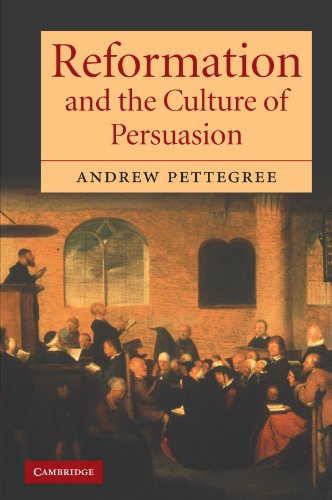
Reformation and the Culture of Persuasion by Andrew Pettegree
Why did people choose the Reformation? What was it in the evangelical teaching that excited, moved or persuaded them? Andrew Pettegree here tackles these questions directly by re-examining the reasons that moved millions to this decisive and traumatic break with a shared Christian past. He charts the separation from family, friends, and workmates that adherence to the new faith often entailed and the new solidarities that emerged in their place. He explores the different media of conversion through which the Reformation message was communicated and imbibed - the role of drama, sermons, song and the book - and argues that the potency of print can only be understood as working in harmony with more traditional modes of communication. His findings offer a persuasive new answer to the critical question of how the Reformation could succeed as a mass movement in an age before mass literacy.
'Andrew Pettegree's new book offers an energetic and stimulating reassessment of the way Reformation both exploited and created 'a culture of persuasion' … Reformation and the Culture of Persuasion will sustain and fuel the still lively debate about the character, impact and progress of this momentous movement of religious renewal.' The Times Literary Supplement
'There is no one better qualified to provide an overview of where we now stand than Andrew Pettegree, who from the Reformation Studies Institute at St Andrews University surveys the newest work in the field. He is an authority on the formation of Calvinist communities and on the dynamic role of the book trade in the various reformations that changed the face of Europe … Pettegree is at his best in his account of print and the book trade, grounded in knowledge of the economics and organisation of the industry'. The Times Higher Education Supplement
'Reformation and the Culture of Persuasion is a thoughtful and elegant addition to desk, bookshelf and scholarship.' The Journal of Ecclesiastical History
'… no one has brought together such a diverse range of material on the Reformation's media with such economy and critical astuteness. Pettegree's book is also admirably written, free of jargon and pitched to a broad audience. As such, it is ideal to use in the classroom too, where it should provoke much debate and discussion.' Sixteenth Century Journal
'There is no one better qualified to provide an overview of where we now stand than Andrew Pettegree, who from the Reformation Studies Institute at St Andrews University surveys the newest work in the field. He is an authority on the formation of Calvinist communities and on the dynamic role of the book trade in the various reformations that changed the face of Europe … Pettegree is at his best in his account of print and the book trade, grounded in knowledge of the economics and organisation of the industry'. The Times Higher Education Supplement
'Reformation and the Culture of Persuasion is a thoughtful and elegant addition to desk, bookshelf and scholarship.' The Journal of Ecclesiastical History
'… no one has brought together such a diverse range of material on the Reformation's media with such economy and critical astuteness. Pettegree's book is also admirably written, free of jargon and pitched to a broad audience. As such, it is ideal to use in the classroom too, where it should provoke much debate and discussion.' Sixteenth Century Journal
Andrew Pettegree is Professor of Modern History and Founding Director of the Reformation Studies Institute at the University of St Andrews. He is the author of a number of studies of the European Reformation, sixteenth century Europe, and the history of the printed book.
| SKU | Unavailable |
| ISBN 13 | 9780521602648 |
| ISBN 10 | 0521602645 |
| Title | Reformation and the Culture of Persuasion |
| Author | Andrew Pettegree |
| Condition | Unavailable |
| Binding Type | Paperback |
| Publisher | Cambridge University Press |
| Year published | 2005-06-23 |
| Number of pages | 252 |
| Cover note | Book picture is for illustrative purposes only, actual binding, cover or edition may vary. |
| Note | Unavailable |