
Religious Architecture in Latium and Etruria, c. 900-500 BC


Summary
The feel-good place to buy books
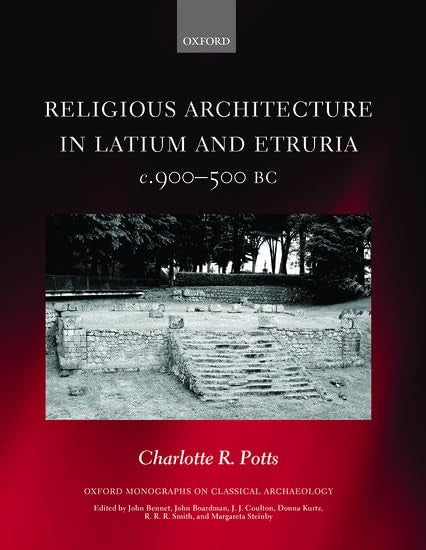
Religious Architecture in Latium and Etruria, c. 900-500 BC by Charlotte R Potts
Religious Architecture in Latium and Etruria c. 900-500 BC presents the first comprehensive treatment of cult buildings in western central Italy from the Iron Age to the Archaic Period. By analysing the archaeological evidence for the form of early religious buildings and their role in ancient communities, it reconstructs a detailed history of early Latial and Etruscan religious architecture that brings together the buildings and the people who used them.The first part of the study examines the processes by which religious buildings changed from huts and shrines to monumental temples, and explores apparent differences between these processes in Latium and Etruria. The second part analyses the broader architectural, religious, and topographical contexts of the first Etrusco-Italic temples alongside possible rationales for their introduction. The result is a new and extensive account of when, where, and why monumental cult buildings became features of early central Italic society and set precedents for the great temples of republican Rome.
Well prepared (including a chronology), well written (explanatory, clear and jargon-light), an incisive re-examination of the hefty secondary literature, an engagement with theory and debates on urbanisation cultural contact/exchange, but always focused on the evidence (and on the people who used them as well as the buildings themselves), and well presented: two maps, 42 figures and 95 illustrations as plates, all clear* Gocha R. Tsetskhladze, Ancient West and East (AWE) *
A highly valuable reassessment and interpretation of the archaeological corpus which has wide-ranging implications for our understanding of early Italic history. * Sinclair Bell (Northern Illinois University), The Journal of Roman Studies Vol.107 *
a welcome and important work in the field of pre-Roman archaeology ... It is an internationally important achievement with a huge impact on the study of ancient architecture. Her book offers many new insights and urges the reader to reconsider established views. It is a rich, well-argued, and impeccably researched study, which will surely have a major impact on its field. * Patricia S. Lulof, University of Amsterdam *
The special emphasis placed on the development of monumental religious architecture as a means of encouraging cross-cultural contact will also appeal to specialists interested in Mediterranean connectivity and urbanization. The value of the book lies primarily in the synthesis of an impressive amount of archaeological material in English, with an emphasis on the data recovered from the past fifty years or so of systematic excavation and study. The book's secondary value lies in the author's use of the archaeological evidence to challenge existing hypotheses concerning the identification of religious buildings and to propose new ways of understanding the role of monumentalization in the reconstruction of ancient societies. * J. Marilyn Evans, Bryn Mawr Classical Review *
A highly valuable reassessment and interpretation of the archaeological corpus which has wide-ranging implications for our understanding of early Italic history. * Sinclair Bell (Northern Illinois University), The Journal of Roman Studies Vol.107 *
a welcome and important work in the field of pre-Roman archaeology ... It is an internationally important achievement with a huge impact on the study of ancient architecture. Her book offers many new insights and urges the reader to reconsider established views. It is a rich, well-argued, and impeccably researched study, which will surely have a major impact on its field. * Patricia S. Lulof, University of Amsterdam *
The special emphasis placed on the development of monumental religious architecture as a means of encouraging cross-cultural contact will also appeal to specialists interested in Mediterranean connectivity and urbanization. The value of the book lies primarily in the synthesis of an impressive amount of archaeological material in English, with an emphasis on the data recovered from the past fifty years or so of systematic excavation and study. The book's secondary value lies in the author's use of the archaeological evidence to challenge existing hypotheses concerning the identification of religious buildings and to propose new ways of understanding the role of monumentalization in the reconstruction of ancient societies. * J. Marilyn Evans, Bryn Mawr Classical Review *
Charlotte R. Potts is the Sybille Haynes Lecturer in Etruscan and Italic Archaeology and Art at the University of Oxford and the Woolley Fellow in Archaeology at Somerville College.
| SKU | Unavailable |
| ISBN 13 | 9780198722076 |
| ISBN 10 | 0198722079 |
| Title | Religious Architecture in Latium and Etruria, c. 900-500 BC |
| Author | Charlotte R Potts |
| Series | Oxford Monographs On Classical Archaeology |
| Condition | Unavailable |
| Binding Type | Hardback |
| Publisher | Oxford University Press |
| Year published | 2015-11-26 |
| Number of pages | 258 |
| Cover note | Book picture is for illustrative purposes only, actual binding, cover or edition may vary. |
| Note | Unavailable |