


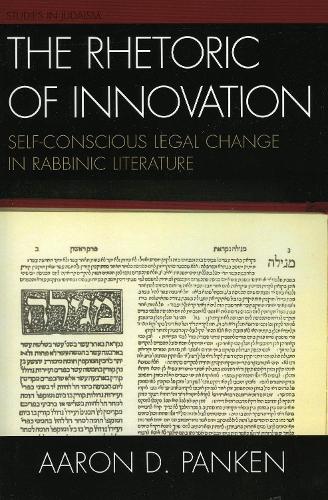
The Rhetoric of Innovation by Aaron D Panken
A profound tension exists between the opposing tendencies of preservation and innovation in rabbinic legal literature. The rabbis made tremendous attempts to safeguard traditions handed down to them from prior generations in the face of significant new challenges. At the same time, these creative religious thinkers boldly invented new practices (or altered old ones) to fit shifting circumstances, designing and utilizing a rich rhetorical vocabulary to allow such necessary innovation. Through critical examination of more than 1,000 occurrences of terms depicting legal innovation, this study maps the contours of legal change reported during the rabbinic period. The Rhetoric of Innovation examines temporal clusters of statements and actions attributed to authority figures in the Tannaitic and Amoraic periods, also reviewing the geographic distribution of these words and their divergent usages in documents edited in Roman Palestine and Babylonia. It also provides significant insight into rabbinic philosophies of legal change, through exploring the various rationales deemed acceptable within the rabbinic corpus. In this respect the book carries a relevant message for modern Jewish life in its consideration of the history of appropriate boundaries and reasons for legal change-questions that recur frequently in Jewish discourse today.
In this thoroughly researched volume, Aaron Panken has uncovered the methods of development employed by the sages of Jewish law in the Talmudic period and the ongoing response of halakhah to changing circumstances and conditionsThe volume is marked by careful scholarship and objectivity and is an important contribution to the history of Jewish law. -- Lawrence H. Schiffman, Ethel and Irvin A. Edelman Professor of Hebrew and Judaic Studies, New York University
Aaron Panken's book illustrates the value of approaching rabbinic literature through its discrete documents rather than as an undifferentiated corpus of writing. His thoughtful analyses demonstrate that even the terminology of the halakhah is affected-perhaps even shaped-by the document in which it appears. This is an important finding. Serious students of rabbinic Judaism will benefit from working through the materials and arguments of this learned book. -- William Scott Green, Professor of Religion and Philip S. Bernstein Professor of Judaic Studies, University of Rochester
In this erudite and remarkably comprehensive study of legal change in classical rabbinic literature, Aaron Panken makes a signal contribution to our knowledge of Jewish law and its development throughout the Talmudic period of Jewish history. Panken surveys the entire corpus of Tannaitic and Amoraic sources relevant to his topic, and employs philosophical and literary theory to frame his analysis of texts. His absolute command of the secondary literature on the topic gives this book an added depth andutility, and this book constitutes a most important addition to scholarship in the field. Students of classical rabbinic literature, of comparative law in the Ancient Near East, and of post-Talmudic Jewish jurisprudence will find this book an absolute treasure-trove for their own study and reflection. Aaron Panken is to be congratulated for this masterful study. -- Rabbi David Ellenson, President, Hebrew Union College-Jewish Institute of Religion
In this erudite and remarkably comprehensive study of legal change in classical rabbinic literature, Aaron Panken makes a signal contribution to our knowledge of Jewish law and its development throughout the Talmudic period of Jewish history. Panken surveys the entire corpus of Tannaitic and Amoraic sources relevant to his topic, and employs philosophical and literary theory to frame his analysis of texts. His absolute command of the secondary literature on the topic gives this book an added depth and utility, and this book constitutes a most important addition to scholarship in the field. Students of classical rabbinic literature, of comparative law in the Ancient Near East, and of post-Talmudic Jewish jurisprudence will find this book an absolute treasure-trove for their own study and reflection. Aaron Panken is to be congratulated for this masterful study. -- Rabbi David Ellenson, President, Hebrew Union College-Jewish Institute of Religion
Aaron Panken's book illustrates the value of approaching rabbinic literature through its discrete documents rather than as an undifferentiated corpus of writing. His thoughtful analyses demonstrate that even the terminology of the halakhah is affected-perhaps even shaped-by the document in which it appears. This is an important finding. Serious students of rabbinic Judaism will benefit from working through the materials and arguments of this learned book. -- William Scott Green, Professor of Religion and Philip S. Bernstein Professor of Judaic Studies, University of Rochester
In this erudite and remarkably comprehensive study of legal change in classical rabbinic literature, Aaron Panken makes a signal contribution to our knowledge of Jewish law and its development throughout the Talmudic period of Jewish history. Panken surveys the entire corpus of Tannaitic and Amoraic sources relevant to his topic, and employs philosophical and literary theory to frame his analysis of texts. His absolute command of the secondary literature on the topic gives this book an added depth andutility, and this book constitutes a most important addition to scholarship in the field. Students of classical rabbinic literature, of comparative law in the Ancient Near East, and of post-Talmudic Jewish jurisprudence will find this book an absolute treasure-trove for their own study and reflection. Aaron Panken is to be congratulated for this masterful study. -- Rabbi David Ellenson, President, Hebrew Union College-Jewish Institute of Religion
In this erudite and remarkably comprehensive study of legal change in classical rabbinic literature, Aaron Panken makes a signal contribution to our knowledge of Jewish law and its development throughout the Talmudic period of Jewish history. Panken surveys the entire corpus of Tannaitic and Amoraic sources relevant to his topic, and employs philosophical and literary theory to frame his analysis of texts. His absolute command of the secondary literature on the topic gives this book an added depth and utility, and this book constitutes a most important addition to scholarship in the field. Students of classical rabbinic literature, of comparative law in the Ancient Near East, and of post-Talmudic Jewish jurisprudence will find this book an absolute treasure-trove for their own study and reflection. Aaron Panken is to be congratulated for this masterful study. -- Rabbi David Ellenson, President, Hebrew Union College-Jewish Institute of Religion
Aaron D. Panken serves as Dean and Director of the Rabbinical Program at Hebrew Union College-Jewish Institute of Religion in New York City, where he teaches Rabbinic and Second Temple Literature. Ordained at HUC-JIR, he earned his Ph.D. in Hebrew and Judaic Studies from New York University and teaches and speaks widely throughout North America and abroad.
| SKU | Unavailable |
| ISBN 13 | 9780761831662 |
| ISBN 10 | 0761831665 |
| Title | The Rhetoric of Innovation |
| Author | Aaron D Panken |
| Series | Studies In Judaism |
| Condition | Unavailable |
| Binding Type | Paperback |
| Publisher | University Press of America |
| Year published | 2005-06-02 |
| Number of pages | 406 |
| Cover note | Book picture is for illustrative purposes only, actual binding, cover or edition may vary. |
| Note | Unavailable |