


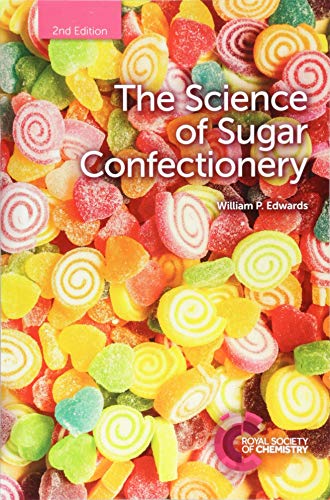
Science of Sugar Confectionery by William P Edwards
Since the first edition of The Science of Sugar Confectionery (2000), the confectionery industry has responded to ever-changing consumer habits. This new edition has been thoroughly revised to reflect industrys response to market driven nutrition and dietary concerns, as well as changes in legislation, labelling, and technology.'Sweets for my sweet, sugar for my honey', so sang The Searchers pop group in 1963, and it seemed an innocent way of praising a loved oneUnthinkable today, of course, since sugar is regarded as something to be avoided at all costs, and now to be taxed when added to soft drinks. Sugar is seen as a major contributor to obesity and Type-2 diabetes, conditions which are becoming more prevalent.
This is not the first time that sugar has come under attack. Almost 50 years ago, in 1972, John Yudkin's bestseller, 'Pure, white, and deadly', sugar was deemed the carbohydrate of which we consumed far too much in the UK, adding it in spoonfuls to the many cups of tea we drank every day.
Sugar is still a major ingredient in sweets, and these are the subject of chemist William Edward's book, The Science of Sugar Confectionery. In this second edition he deals, thoroughly, with the changes that have come about since the first edition in 2000, including diertary concerns and changes in legislation, labelling and technology. This is not a book that apologises for its subject matter, and it covers all aspects of an important industry producing a large range of products.
Edwards devotes a chapter that includes a section on dieting, calorie-counting and weight-loss regimes, which regard sweets as something to be avoided. Yet sweetness is a sensation that we are genetically disposed to like, even to crave.
Many chemists work in the food-related industries, and a number of them will no doubt work for companies that produce sweets. They will be aware of ingredients, which have come under attack in recent years, such as colourants, flavours, and preservatives - and all are a possible threat to health.
Edwards deals with them in detail and points out that more effort has been put into tackling these issues than ever went into formulating the traditional sweets in the first place. And not without success, as in the case of the ever popular Rowntree's Fruit Pastilles. These famous treats continue to be sold because its creators have been able to modify the ingredients to make them acceptable - at least for now.
* Chemistry and Industry Issue 03 2019 *In this second edition he deals, thoroughly, with the changes that have come about since the first edition in 2000, including dietary concerns and changes in legislation, labelling and technology. This is not a book that apologies for its subject matter, and it covers all aspects of an important industry producing a large range of products.
* Chemistry and Industry Issue 03 2019 *| SKU | Unavailable |
| ISBN 13 | 9781788011334 |
| ISBN 10 | 1788011333 |
| Title | Science of Sugar Confectionery |
| Author | William P Edwards |
| Condition | Unavailable |
| Binding Type | Paperback |
| Publisher | Royal Society of Chemistry |
| Year published | 2018-10-26 |
| Number of pages | 240 |
| Cover note | Book picture is for illustrative purposes only, actual binding, cover or edition may vary. |
| Note | Unavailable |