


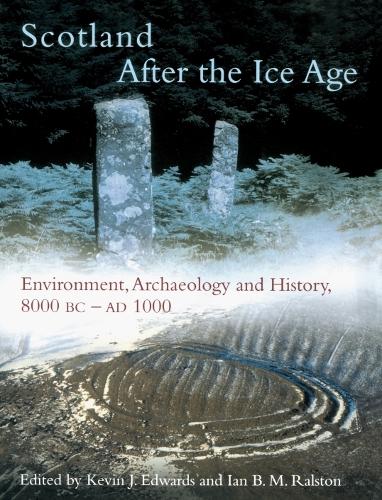
Scotland After the Ice Age by Kevin J Edwards
This book charts the environmental transformation of Scotland from the end of the ice age in an empty land 10,000 years ago to the Viking invasions of an established society 9,000 years later. When the icefields and glaciers disappeared forests covered the land and sea level rose to create the Hebridean islands. Elk, aurochs, bear, boar, red deer, beaver and horse crossed the land bridge from Europe to colonise the land, first followed by hunter gatherers and later by waves of Celts, Romans, Scots, and Normans, each marking the landscape in distinctive ways. This book brings together environmental, ecological, historical, geological, and archaeological approaches to show how changing climatic conditions and this sequence of cultural impacts shaped the succession of Scottish landscapes which have led to its present unique, beautiful, fleeting forms and variety.The seventeen authors are scholars from a range of fields, all writing for students and general readers. The first six chapters consider interactions of human ecology, climate, landscape, soils, vegetation and faunal change. The next seven are a chronological narrative history of Scotland's environment over 9,000 years. The final chapter unites these systematic and historical approaches. The book is extensively illustrated with maps and photographs. The paperback edition includes a new and extensive guide to further reading.
Includes a welcome guide to the vast array of literature that has emerged since the mid-nineties! brings together environmental and archaeological approaches to shed very considerable light on Scotland's cultural landscapesThis volume is an important survey of an emerging science and as such has the potential to act as a stimulus for renewed and refocused research for years to come. The editors should be congratulated on the way in which they have undertaken their task, as the book is comprehensive, wide-ranging and well-organised. On the whole, it achieves its aims... The book is an impressive volume... indispensable. Includes a welcome guide to the vast array of literature that has emerged since the mid-nineties! brings together environmental and archaeological approaches to shed very considerable light on Scotland's cultural landscapes. This volume is an important survey of an emerging science and as such has the potential to act as a stimulus for renewed and refocused research for years to come. The editors should be congratulated on the way in which they have undertaken their task, as the book is comprehensive, wide-ranging and well-organised. On the whole, it achieves its aims... The book is an impressive volume... indispensable.
Kevin Edwards is Professor of Physical Geography at the University of Aberdeen. He was previously Professor of Palaeoecology at the University of Sheffield. Ian Ralston is Abercromby Emeritus Professor of Archaeology at the University of Edinburgh, is presently President of the Society of Antiquaries of Scotland. He has excavated hillforts in France at Mont Beuvray in Burgundy and Levroux and Bourges in Berry. The writer of some 150 published papers, he is the author or editor of more than 20 books. Ian has also extensively researched Scottish archaeological topics including both pre- and post-Roman hillforts.
| SKU | Unavailable |
| ISBN 13 | 9780748617364 |
| ISBN 10 | 0748617361 |
| Title | Scotland After the Ice Age |
| Author | Kevin J Edwards |
| Condition | Unavailable |
| Binding Type | Paperback |
| Publisher | Edinburgh University Press |
| Year published | 2003-01-24 |
| Number of pages | 336 |
| Cover note | Book picture is for illustrative purposes only, actual binding, cover or edition may vary. |
| Note | Unavailable |