


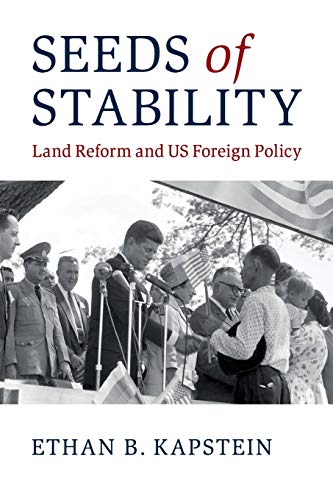
Seeds of Stability by Ethan B Kapstein
Under what conditions do the governments of developing countries manage to reform their way out of political and economic instability? When are they instead overwhelmed by the forces of social conflict? What role can great powers play in shaping one outcome or the other? This book is among the first to show in detail how the United States has used foreign economic policy, including foreign aid, as a tool for intervening in the developing world. Specifically, it traces how the United States promoted land reform as a vehicle for producing political stability. By showing where that policy proved stabilizing, and where it failed, a nuanced account is provided of how the local structure of the political economy plays a decisive role in shaping outcomes on the ground.
'Kapstein's ambitious study represents a landmark contribution to the study of US post-war intervention in the developing worldFocusing on economic reform - and especially land reform - Kapstein shows through meticulous archival work and riveting case studies that the US sought to promote reform in an effort stabilize friendly governments and stem peasant uprisings. The book is a must-read for students of foreign policy, diplomacy, development, and land reform.' Michael Albertus, University of Chicago
'The study of peasant rebellion is back. Ethan B. Kapstein rewrites the history of the Cold War in this fascinating book on the causes and consequences of US foreign-assistance policy. With communism on the march, US policymakers promoted land reform as a way to shore up political stability. Seeds of Stability tells us why they did so and why they were only sometimes successful.' Scott Gehlbach, University of Wisconsin, Madison
'... this book certainly makes a valuable contribution to understanding the mechanisms when such reformist strategies might be effective, the demand and appetite for such interventions on Washington's part in the coming future are likely to be very limited.' Ionut C. Popescu, International Relations
'The study of peasant rebellion is back. Ethan B. Kapstein rewrites the history of the Cold War in this fascinating book on the causes and consequences of US foreign-assistance policy. With communism on the march, US policymakers promoted land reform as a way to shore up political stability. Seeds of Stability tells us why they did so and why they were only sometimes successful.' Scott Gehlbach, University of Wisconsin, Madison
'... this book certainly makes a valuable contribution to understanding the mechanisms when such reformist strategies might be effective, the demand and appetite for such interventions on Washington's part in the coming future are likely to be very limited.' Ionut C. Popescu, International Relations
Ethan B. Kapstein holds the Arizona Centennial Chair at Arizona State University, where he is affiliated with the McCain Institute for International Leadership, and is also Associate Director of the Empirical Studies of Conflict Program, based at Princeton University. He is co-author (with John Busby) of AIDS Drugs for All: Social Movements and Market Transformations (Cambridge, 2013), which won the Don K. Price Award for best book on Science, Technology and Environmental Studies from the American Political Science Association.
| SKU | Unavailable |
| ISBN 13 | 9781316636640 |
| ISBN 10 | 131663664X |
| Title | Seeds of Stability |
| Author | Ethan B Kapstein |
| Condition | Unavailable |
| Binding Type | Paperback |
| Publisher | Cambridge University Press |
| Year published | 2017-05-09 |
| Number of pages | 316 |
| Cover note | Book picture is for illustrative purposes only, actual binding, cover or edition may vary. |
| Note | Unavailable |