
The Self-Giving God and Salvation History


World of Books
The feel-good place to buy books
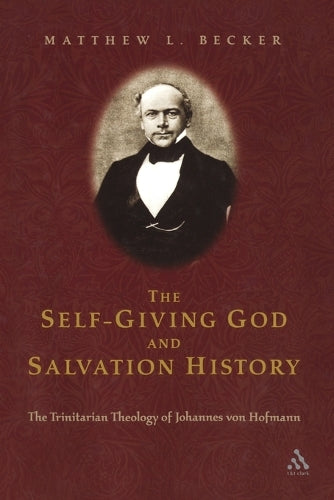
The Self-Giving God and Salvation History by Matthew L Becker
Hofmann (1810-1877) was one of the most significant theologians of the 19th century and perhaps the century's most influential Lutheran theologian. Becker introduces us to Hofmann's trinitarian view of God. According to Hofmann, God freely chose to give himself out of divine love. Becker's book centres on Hofmann's understanding of history. In Hofmann's trinitarian kenosis, the eternal God has become historical by self-emptying God's self into Jesus. For Hofmann, world history can only be understood within the historical self-giving of the triune God who is love. Thus, for Hofmann all of history is salvation-history, a kind of history that embraces and fulfils God's purposes in the world.
'a very fine piece of historical theology' - Theodore Vial, Biblica -- Theodore Vial
"Heilsgeschichte is the one German word every student of theology learns. Here Matthew Becker introduces us to the father of the "history of salvation" way of thinking that Oscar Cullmann popularized in Christ and Time. An added bonus is Becker's surprising thesis that, contrary to common opinion, trinitarian theology was alive and well in the nineteenth century, prior to its alleged rebirth in the dogmatics of Karl Barth." —-The Rev. Dr. Carl E. Braaten, Executive Director, Center for Catholic and Evangelical Theology -- The Rev. Dr. Carl E. Braaten * Blurb from reviewer *
"This book has two purposes: the first, to introduce readers to a significant but largely forgotten Lutheran theologian, Johannes von Hofmann (1810-77); the second, to correct misunderstandings of Hofmann's theology... Along the way are excellent discussions of Hofmann's intellectual relation to Hegel, Schleiermacher, and others. The author also does a good job of relating Hofmann's thought to recent trends, such as hermeneutical theory and Pannenberg's thought. This book will be of value to those interested in understanding controversies in nineteenth-century Protestant theology and the way in which they anticipate current issues."- Samuel M. Powell, Theology Today, January 2006 * Theology Today *
"Heilsgeschichte is the one German word every student of theology learns. Here Matthew Becker introduces us to the father of the "history of salvation" way of thinking that Oscar Cullmann popularized in Christ and Time. An added bonus is Becker's surprising thesis that, contrary to common opinion, trinitarian theology was alive and well in the nineteenth century, prior to its alleged rebirth in the dogmatics of Karl Barth." —-The Rev. Dr. Carl E. Braaten, Executive Director, Center for Catholic and Evangelical Theology -- The Rev. Dr. Carl E. Braaten * Blurb from reviewer *
"This book has two purposes: the first, to introduce readers to a significant but largely forgotten Lutheran theologian, Johannes von Hofmann (1810-77); the second, to correct misunderstandings of Hofmann's theology... Along the way are excellent discussions of Hofmann's intellectual relation to Hegel, Schleiermacher, and others. The author also does a good job of relating Hofmann's thought to recent trends, such as hermeneutical theory and Pannenberg's thought. This book will be of value to those interested in understanding controversies in nineteenth-century Protestant theology and the way in which they anticipate current issues."- Samuel M. Powell, Theology Today, January 2006 * Theology Today *
Matthew L. Becker is a Professor of Theology at Concordia University, Portland, Oregon. An ordained Lutheran minister, Dr. Becker has served congregations in Chicago and Oregon. He is a co-editor of God Opens Doors, a history of the Lutheran Church-Missouri Synod in the Pacific Northwest.
| SKU | Unavailable |
| ISBN 13 | 9780567027207 |
| ISBN 10 | 0567027201 |
| Title | The Self-Giving God and Salvation History |
| Author | Matthew L Becker |
| Condition | Unavailable |
| Binding Type | Paperback |
| Publisher | Bloomsbury Publishing PLC |
| Year published | 2004-11-01 |
| Number of pages | 304 |
| Cover note | Book picture is for illustrative purposes only, actual binding, cover or edition may vary. |
| Note | Unavailable |