
Sensory Perceptual Issues in Autism and Asperger Syndrome


Summary
The feel-good place to buy books
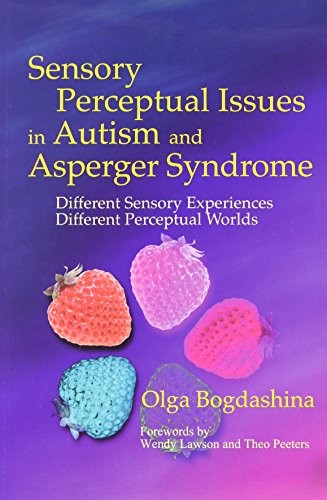
Sensory Perceptual Issues in Autism and Asperger Syndrome by Wendy Lawson
Bogdashina attempts to define the role of sensory perceptual problems in autism identified by autistic individuals themselves. She singles out possible patterns of sensory experiences in autism and the cognitive differences caused by them. The final chapters are devoted to assessment and intervention.
What's great about her 2003 book Sensory Perceptual Issues in Autism and Asperger Syndrome is that as well as summing up the psysiology of sensory problems, she helps parents and professionals to decipher the exact nature of perceptual difficulties through observing a child's behaviourThis is practical, helpful, clear and concise, if you suspect sensory issues are a factor in your child's condition, I'd recommend a read. -- Aukids Magazine
Sensory Perceptual Issues in Autism and Asperger Syndrome enables teachers and other professionals, parents and people with autism themselves to fully comprehend sensory perceptual differences in autism. -- Adolescence
Bogdashina presents a very convincing argument that many of the behavioural patterns seen in people with Autism and Asperger Syndrome have a different sensory perceptual experience than people without these conditions. The experiences may involve hyper- or hyposensitivity, fluctuation between different "volumes" of perception or difficulty interpreting a sense. Any, and frequently several, sensory modalities are affected in an individual. This book is easily understood by both parents and professionals. It is well referenced. The Table of Contents and the Subject and Author Indexes are easy to use. This book may be a good place to start learning about the altered sensory experience of people with Autism or Asperger Syndrome. -- The Journal of the Canadian Academy of Child and Adolescent Psychiatry
Examples of experiences from autistic people provide a useful insight into the range and variability of these experiences and a stark reminder of the pervasive nature of autism. As a clinician, this book has helped to reinforce the need to look at behaviours from an 'autistic perspective' and pick up on 'the clues' with reference to sensory perceptual difficulties and has been extremely valuable to me for my role within an autism diagnostic team. I would recommend this book to all occupational therapists working within the field of autism. -- Napot Journal
This is a great book. There are so many books on the market where experts presume to know better than autistic people themselves and disregard autistic peoples own accounts of what it feels like to be autistic, but this one breaks that mould. It is not only packed with factual information about how the brain and the senses work, it explores the autistic experience with an open and enquiring mind, while still tying all this in with conventional explanations of autism and results from existing studies. This book has a great potential to be useful, not just to parents and autistic people themselves who are looking for information and understanding, but to educators and service providers, whom it could inspire and advise. Interesting and accessible, I sat down today and read it the whole way through. Highly recommended. -- Asperger Information.net
It is refreshing to read a book that focuses on the wider aspects of autism rather than just the language, social and communication needs of the child/adult. -- Bulletin
This would be useful in a multidisciplinary team approach to autism spectrum disorder provision. -- Speech & Language Therapy in Practice
Sensory Perceptual Issues in Autism and Asperger Syndrome enables teachers and other professionals, parents and people with autism themselves to fully comprehend sensory perceptual differences in autism. -- Adolescence
Bogdashina presents a very convincing argument that many of the behavioural patterns seen in people with Autism and Asperger Syndrome have a different sensory perceptual experience than people without these conditions. The experiences may involve hyper- or hyposensitivity, fluctuation between different "volumes" of perception or difficulty interpreting a sense. Any, and frequently several, sensory modalities are affected in an individual. This book is easily understood by both parents and professionals. It is well referenced. The Table of Contents and the Subject and Author Indexes are easy to use. This book may be a good place to start learning about the altered sensory experience of people with Autism or Asperger Syndrome. -- The Journal of the Canadian Academy of Child and Adolescent Psychiatry
Examples of experiences from autistic people provide a useful insight into the range and variability of these experiences and a stark reminder of the pervasive nature of autism. As a clinician, this book has helped to reinforce the need to look at behaviours from an 'autistic perspective' and pick up on 'the clues' with reference to sensory perceptual difficulties and has been extremely valuable to me for my role within an autism diagnostic team. I would recommend this book to all occupational therapists working within the field of autism. -- Napot Journal
This is a great book. There are so many books on the market where experts presume to know better than autistic people themselves and disregard autistic peoples own accounts of what it feels like to be autistic, but this one breaks that mould. It is not only packed with factual information about how the brain and the senses work, it explores the autistic experience with an open and enquiring mind, while still tying all this in with conventional explanations of autism and results from existing studies. This book has a great potential to be useful, not just to parents and autistic people themselves who are looking for information and understanding, but to educators and service providers, whom it could inspire and advise. Interesting and accessible, I sat down today and read it the whole way through. Highly recommended. -- Asperger Information.net
It is refreshing to read a book that focuses on the wider aspects of autism rather than just the language, social and communication needs of the child/adult. -- Bulletin
This would be useful in a multidisciplinary team approach to autism spectrum disorder provision. -- Speech & Language Therapy in Practice
Dr Wendy Lawson, a psychologist, qualified counsellor and social worker has operated her own private practice for many years. Wendy was awarded fourth place as ‘Victorian Australian of the year' in 2008. Originally diagnosed as being intellectually disabled, then in her teens as being schizophrenic, and finally in 1994, Wendy was diagnosed as being on the autism spectrum. The mother of four children, Wendy has been married, separated and divorced, has experienced the death of one of her teenage sons, lost friends and status due to being openly gay, faced ill health and recently is coming to terms with the fact that she is aging! Wendy's youngest son is also on the autism spectrum. Professor Olga Bogdashina, MA, PhD, DEd, CO-founder of and Programme Leader (Autism courses) at the International Autism Institute, KSPU and co-founder of the International Consortium of Autism Institutes. She has worked extensively in the field of autism as a teacher, lecturer and researcher, with a particular interest in sensory-perceptual, cognitive and communication problems. She is a Visiting Professor in Autism Studies at universities around the world, develops university (Autism Study) courses and training programmes for professionals and parents, presents at national and international autism conferences and is an autism consultant for services for children and adults. Olga has an adult son with autism and lives in Yorkshire, UK.
| SKU | Unavailable |
| ISBN 13 | 9781843101666 |
| ISBN 10 | 1843101661 |
| Title | Sensory Perceptual Issues in Autism and Asperger Syndrome |
| Author | Wendy Lawson |
| Condition | Unavailable |
| Binding Type | Paperback |
| Publisher | Jessica Kingsley Publishers |
| Year published | 2003-06-15 |
| Number of pages | 224 |
| Cover note | Book picture is for illustrative purposes only, actual binding, cover or edition may vary. |
| Note | Unavailable |