


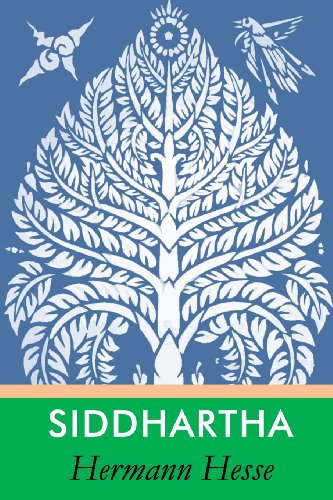
Siddhartha by Hermann Hesse
Siddhartha is a novel by Hermann Hesse that deals with the spiritual journey of self-discovery of a man named Siddhartha during the time of the Gautama Buddha. The story takes place in Nepalese plain land-Kapilvastu. Siddhartha decides to leave behind his home in the hope of gaining spiritual illumination by becoming an ascetic wandering beggar of the Shramanas. Joined by his best friend Govinda, Siddhartha fasts, becomes homeless, renounces all personal possessions, and intensely meditates, eventually seeking and personally speaking with Gautama, the famous Buddha, or Enlightened One. Afterward, both Siddhartha and Govinda acknowledge the elegance of the Buddha's teachings. Although Govinda hastily joins the Buddha's order, Siddhartha does not follow, claiming that the Buddha's philosophy, though supremely wise, does not account for the necessarily distinct experiences of each person. He argues that the individual seeks an absolutely unique and personal meaning that cannot be presented to him by a teacher. He thus resolves to carry on his quest alone. Siddhartha crosses a river, and the generous ferryman, whom Siddhartha is unable to pay, merrily predicts that Siddhartha will return to the river later to compensate him in some way. Venturing onward toward city life, Siddhartha discovers Kamala, the most beautiful woman he has yet seen. Kamala, a courtesan, notes Siddhartha's handsome appearance and fast wit, telling him that he must become wealthy to win her affections so that she may teach him the art of love. Although Siddhartha despised materialistic pursuits as a Shramana, he agrees now to Kamala's suggestions. She directs him to the employ of Kamaswami, a local businessman, and insists that he have Kamaswami treat him as an equal rather than an underling. Siddhartha easily succeeds, providing a voice of patience and tranquility, which Siddhartha learned from his days as an ascetic, against Kamaswami's fits of passion. Thus Siddhartha becomes a rich man and Kamala's lover, though in his middle years he realizes that the luxurious lifestyle he has chosen is merely a game, empty of spiritual fulfillment. Leaving the fast-paced bustle of the city, Siddhartha returns to the river and thinks of killing himself. He is saved only by an internal experience of the holy word, Om. The very next morning Siddhartha briefly reconnects with Govinda, who is passing through the area as a wandering Buddhist.
In the 1960s, especially in the United States, the novels of Hermann Hesse were widely embraced by young readers who found in his protagonists a reflection of their own search for meaning in a troubled world. Hesse's rich allusions to world mythologies, especially those of Asia, and his persistent theme of the individual striving for integrity in opposition to received opinions and mass culture appealed to a generation in upheaval and in search of renewed values. Born in southern Germany in 1877, Hesse came from a family of missionaries, scholars, and writers with strong ties to India. This early exposure to the philosophies and religions of Asia--filtered and interpreted by thinkers thoroughly steeped in the intellectual traditions and currents of modern Europe--provided Hesse with some of the most pervasive elements in his short stories and novels, especially Siddhartha (1922) and Journey to the East (1932). Hesse concentrated on writing poetry as a young man, but his first successful book was a novel, Peter Camenzind (1904). The income it brought permitted him to settle with his wife in rural Switzerland and write full-time. By the start of World War I in 1914, Hesse had produced several more novels and had begun to write the considerable number of book reviews and articles that made him a strong influence on the literary culture of his time. During the war, Hesse was actively involved in relief efforts. Depression, criticism for his pacifist views, and a series of personal crises--combined with what he referred to as the war psychosis of his times--led Hesse to undergo psychoanalysis with J. B. Lang, a student of Carl Jung. Out of these years came Demian (1919), a novel whose main character is torn between the orderliness of bourgeois existence and the turbulent and enticing world of sensual experience. This dichotomy is prominent in Hesse's subsequent novels, including Siddhartha (1922), Steppenwolf (1927), and Narcissus and Goldmund (1930). Hesse worked on his magnum opus, The Glass Bead Game (1943), for twelve years. This novel was specifically cited when he was awarded the Nobel Prize for Literature in 1946. Hesse died at his home in Switzerland in 1962. Calling his life a series of crises and new beginnings, Hesse clearly saw his writing as a direct reflection of his personal development and his protagonists as representing stages in his own evolution. In the 1950s, Hesse described the dominant theme of his work: From Camenzind to Steppenwolf and Josef Knecht [protagonist of The Glass Bead Game], they can all be interpreted as a defense (sometimes also as an SOS) of the personality, of the individual self. Joachim Neugroschel (translator) has won three PEN translation awards and the French-American translation prize. He has also translated Thomas Mann's Death in Venice and Sacher-Masoch's Venus in Furs, both for Penguin Classics. He lives in Brooklyn, New York. Ralph Freedman (introducer), Professor Emeritus of Comparative Literature at Princeton University, is acclaimed for his biographies Hermann Hesse: Pilgrim of Crisis, and Life of a Poet: Rainer Maria Rilke.
| SKU | Unavailable |
| ISBN 13 | 9781484067413 |
| ISBN 10 | 148406741X |
| Title | Siddhartha |
| Author | Hermann Hesse |
| Condition | Unavailable |
| Binding Type | Paperback |
| Publisher | Createspace |
| Year published | 2013-04-07 |
| Number of pages | 106 |
| Cover note | Book picture is for illustrative purposes only, actual binding, cover or edition may vary. |
| Note | Unavailable |