


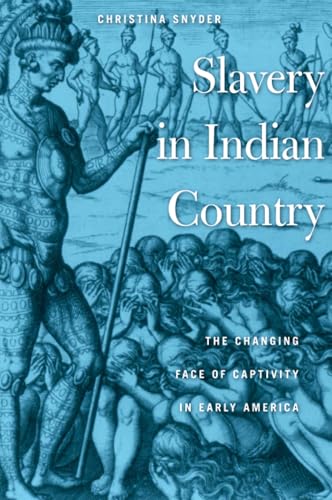
Slavery in Indian Country by Christina Snyder
Slavery existed in North America long before the first Africans arrived at Jamestown in 1619. For centuries, from the pre-Columbian era through the 1840s, Native Americans took prisoners of war and killed, adopted, or enslaved them. Christina Snyder's pathbreaking book takes a familiar setting for bondage, the American South, and places Native Americans at the center of her engrossing story. Indian warriors captured a wide range of enemies, including Africans, Europeans, and other Indians. Yet until the late eighteenth century, age and gender more than race affected the fate of captives. As economic and political crises mounted, however, Indians began to racialize slavery and target African Americans. Native people struggling to secure a separate space for themselves in America developed a shared language of race with white settlers. Although the Indians' captivity practices remained fluid long after their neighbors hardened racial lines, the Second Seminole War ultimately tore apart the inclusive communities that Native people had created through centuries of captivity. Snyder's rich and sweeping history of Indian slavery connects figures like Andrew Jackson and Cherokee chief Dragging Canoe with little-known captives like Antonia Bonnelli, a white teenager from Spanish Florida, and David George, a black runaway from Virginia. Placing the experiences of these individuals within a complex system of captivity and Indians' relations with other peoples, Snyder demonstrates the profound role of Native American history in the American past.
Until Christina Snyder, no historian has told the story of the constantly evolving Native American tradition of enslavement that long pre-dated the arrival of Europeans and of AfricansCompellingly written and deeply researched, Slavery in Indian Country is a model of how foregrounding Native experiences can transform our understanding of American history. The "Slave South" will never look quite the same again. -- Daniel K. Richter, McNeil Center for Early American Studies, University of Pennsylvania
Snyder illuminates a world where slavery and survival went hand-in-hand, an era when native people were both masters and slaves, and a culture that only gradually learned to define slaves by the color of their skin. Her narrative sweep, unflinching analysis, and astonishing research make this a disturbing and powerful book. -- Adam Rothman, Georgetown University
Snyder skillfully explores Indian captive-taking, associated with warfare from the dawn of time, and its evolution and adaptation to new conditions after Europeans and Africans arrived and captivity was transformed into race-based slavery. Beautifully written, this is Indian and Southern history at its best. -- Kathryn Braund, author of Deerskins and Duffels: The Creek Indian Trade with Anglo-America, 1685-1815
Deeply researched, authoritative, and indispensable, Slavery in Indian Country tells us how slavery as an institution changed from a kin-based to a race-based system and richly evokes what the experience of slavery meant to those who were enslaved. -- Nancy Shoemaker, University of Connecticut
A fascinating new perspective on slavery in the American South, especially valuable for understanding slavery's great variability and change over time, and for offering new insight into race and race-making. -- Peter Kolchin, author of American Slavery
Snyder...explores the Indian practice of enslaving prisoners of war in this instructive and remarkably readable book...She reaches back to early Indian captivity practices—and how conceptions of captives and their roles in Indian communities changed with the arrival of Europeans and Africans. During the colonial period, captives were chosen on the basis of gender and age, not race, but as a nativist movement ("a collective identity as red people") emerged in the late-18th century, Americans, black and white, became the "common enemy." By the early 19th century--when, among other factors, black slaves became more highly valued--Africans were specifically targeted. Snyder breaks new ground in this study [and] reveals pre-colonial Southern history and restores visibility to Native American history in the region. * Publishers Weekly (starred review) *
[Snyder] focuses on the evolution of slavery from the perspective of individual Native American groups. She demonstrates that captivity, before the arrival of Europeans, played an important role in Native societies, as some captives became kinfolk while others became slaves...Highly recommended. -- John Burch * Library Journal *
Snyder illuminates a world where slavery and survival went hand-in-hand, an era when native people were both masters and slaves, and a culture that only gradually learned to define slaves by the color of their skin. Her narrative sweep, unflinching analysis, and astonishing research make this a disturbing and powerful book. -- Adam Rothman, Georgetown University
Snyder skillfully explores Indian captive-taking, associated with warfare from the dawn of time, and its evolution and adaptation to new conditions after Europeans and Africans arrived and captivity was transformed into race-based slavery. Beautifully written, this is Indian and Southern history at its best. -- Kathryn Braund, author of Deerskins and Duffels: The Creek Indian Trade with Anglo-America, 1685-1815
Deeply researched, authoritative, and indispensable, Slavery in Indian Country tells us how slavery as an institution changed from a kin-based to a race-based system and richly evokes what the experience of slavery meant to those who were enslaved. -- Nancy Shoemaker, University of Connecticut
A fascinating new perspective on slavery in the American South, especially valuable for understanding slavery's great variability and change over time, and for offering new insight into race and race-making. -- Peter Kolchin, author of American Slavery
Snyder...explores the Indian practice of enslaving prisoners of war in this instructive and remarkably readable book...She reaches back to early Indian captivity practices—and how conceptions of captives and their roles in Indian communities changed with the arrival of Europeans and Africans. During the colonial period, captives were chosen on the basis of gender and age, not race, but as a nativist movement ("a collective identity as red people") emerged in the late-18th century, Americans, black and white, became the "common enemy." By the early 19th century--when, among other factors, black slaves became more highly valued--Africans were specifically targeted. Snyder breaks new ground in this study [and] reveals pre-colonial Southern history and restores visibility to Native American history in the region. * Publishers Weekly (starred review) *
[Snyder] focuses on the evolution of slavery from the perspective of individual Native American groups. She demonstrates that captivity, before the arrival of Europeans, played an important role in Native societies, as some captives became kinfolk while others became slaves...Highly recommended. -- John Burch * Library Journal *
Christina Snyder is Assistant Professor of American Studies and History at Indiana University.
| SKU | Unavailable |
| ISBN 13 | 9780674064232 |
| ISBN 10 | 0674064232 |
| Title | Slavery in Indian Country |
| Author | Christina Snyder |
| Condition | Unavailable |
| Binding Type | Paperback |
| Publisher | Harvard University Press |
| Year published | 2012-04-02 |
| Number of pages | 344 |
| Prizes | Winner of Berkshire Conference of Women Historians First Book Prize 2010, Winner of SHEAR Book Prizes 2010, Winner of John C. Ewers Award 2012, Commended for OAH Frederick Jackson Turner Award 2011, Short-listed for Frederick Douglass Book Prize 2011, Nominated for Albert J. Beveridge Award 2010, Nominated for Willie Lee Rose Prize 2010, Nominated for Morris D. Forkosch Prize 2010, Nominated for Erminie Wheeler-Voegelin Prize 2010, Nominated for Merle Curti Award 2011 |
| Cover note | Book picture is for illustrative purposes only, actual binding, cover or edition may vary. |
| Note | Unavailable |