


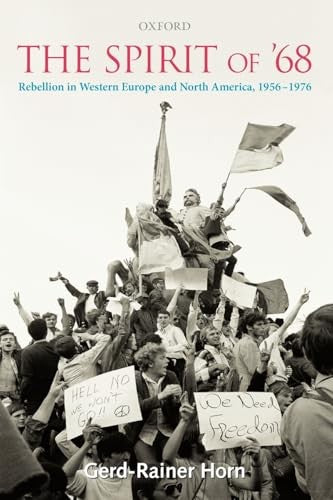
The Spirit of '68 by Gerd-Rainer Horn
In virtually all corners of the Western world, 1968 witnessed a highly unusual sequence of popular rebellions. In Italy, France, Spain, Vietnam, the United States, West Germany, Czechoslovakia, Mexico, and elsewhere, millions of individuals took matters into their own hands to counter imperialism, capitalism, autocracy, bureaucracy, and all forms of hierarchical thinking. Recent reinterpretations have sought to play down any real challenge to the socio-political status quo in these events, but Gerd-Rainer Horn's book offers a spirited counterblast. 1968, he argues, opened up the possibility that economic and political elites on both sides of the Iron Curtain could be toppled from their position of unnatural superiority to make way for a new society where everyday people could, for the first time, become masters of their own destiny. Furthermore, Horn contends, the moment of crisis and opportunity culminating in 1968 must be seen as part of a larger period of experimentation and revolt. The ten years between 1956 and 1966, characterised above all by the flourishing of iconoclastic cultural rebellions, can be regarded as a preparatory period which set the stage for the non-conformist cum political revolts of the subsequent 'red' decade (1966-1976).Horn's geographic centres of attention are Western Europe, including the first full examination of Mediterranean revolts, and North America. He placed particular emphasis on cultural nonconformity, the student movement, working class rebellions, the changing contours of the Left, and the meaning of participatory democracy. His book will make fascinating reading for anyone interested in this turbulent period and the fundamental changes that were wrought upon societies either side of the Atlantic.
Review from previous edition Written from the perspective of a participant observer, this is critical history in the Nietzschean senseAt no point naively optimistic about the chances for success, it nonetheless aims at reviving the volatile Spirit of '68 , and thus at making the potential of the past available for the present. * Kay Schiller, TLS *
...makes for an interesting and stimulating reading not least because of its accessible style, attention to detail, passionate argument and choice of fresh case studie. * Anna Menge, History *
A lively and detailed study...Horn brings an admirable breadth of learning and enthusiasm to his subject. * Steve Andrew, Morning Star *
I strongly recommend it...superb. * International Socialism *
Horn's cosmopolitanism and internationalism are admirable. * Michael Siedman, English Historical Review *
Altogether, the book covers an amazing range not only of countries and dates, but also of social subjects, from students to workers to women...I particularly appreciate the spirit of this book in our time of widespread pessimism. * Luisa Passerini, American Historical Review *
The Spirit of '68 is marked by an impressive mastery of languages and national source-bases, and is particularly valuable for its treatment of previously overlooked cases... It should find a place in both undergraduate and graduate classrooms. * Timothy Scott Brown, European History Quarterly *
...makes for an interesting and stimulating reading not least because of its accessible style, attention to detail, passionate argument and choice of fresh case studie. * Anna Menge, History *
A lively and detailed study...Horn brings an admirable breadth of learning and enthusiasm to his subject. * Steve Andrew, Morning Star *
I strongly recommend it...superb. * International Socialism *
Horn's cosmopolitanism and internationalism are admirable. * Michael Siedman, English Historical Review *
Altogether, the book covers an amazing range not only of countries and dates, but also of social subjects, from students to workers to women...I particularly appreciate the spirit of this book in our time of widespread pessimism. * Luisa Passerini, American Historical Review *
The Spirit of '68 is marked by an impressive mastery of languages and national source-bases, and is particularly valuable for its treatment of previously overlooked cases... It should find a place in both undergraduate and graduate classrooms. * Timothy Scott Brown, European History Quarterly *
Gerd-Rainer Horn, Professor of Twentieth Century History, Institut d'ü¾Ž–Œ¼tudes Politiques de Paris, Sciences Po Born and raised in West Germany, after his Abitur Gerd-Rainer Horn emigrated to the United States where he then lived and worked for twenty-six years, along the way obtaining his B.A. (Minnesota), M.A. and Ph.D. (Michigan). He taught at Montana State and Western Oregon University before moving to
the University of Huddersfield and then the University of Warwick in England. In 2013, Horn finally returned to Europe, now teaching at Sciences Po (Institut d'Etudes Politiques) in Paris. Focussing on the transnational dimension of continental western European social movements between the 1920s and
the 1980s, Horn's particular areas of expertise include the political itinerary of social democracy, the socio-political challenges of the immediate post-WW II period, the cultural and political innovations of the 1960s and 1970s, in addition to the phenomenon of progressive Catholicism in Western
Europe.
| SKU | Unavailable |
| ISBN 13 | 9780199541591 |
| ISBN 10 | 0199541590 |
| Title | The Spirit of '68 |
| Author | Gerd Rainer-Horn |
| Condition | Unavailable |
| Binding Type | Paperback |
| Publisher | Oxford University Press |
| Year published | 2008-10-02 |
| Number of pages | 264 |
| Cover note | Book picture is for illustrative purposes only, actual binding, cover or edition may vary. |
| Note | Unavailable |