
Statistical Methods for Recommender Systems


Summary
The feel-good place to buy books
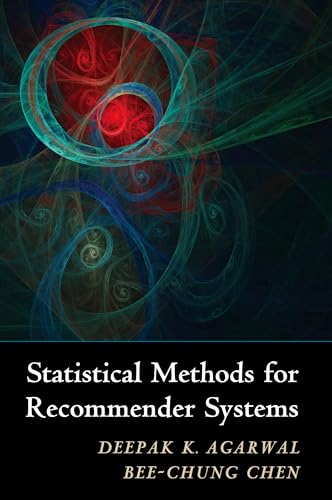
Statistical Methods for Recommender Systems by Deepak K Agarwal
Designing algorithms to recommend items such as news articles and movies to users is a challenging task in numerous web applications. The crux of the problem is to rank items based on users' responses to different items to optimize for multiple objectives. Major technical challenges are high dimensional prediction with sparse data and constructing high dimensional sequential designs to collect data for user modeling and system design. This comprehensive treatment of the statistical issues that arise in recommender systems includes detailed, in-depth discussions of current state-of-the-art methods such as adaptive sequential designs (multi-armed bandit methods), bilinear random-effects models (matrix factorization) and scalable model fitting using modern computing paradigms like MapReduce. The authors draw upon their vast experience working with such large-scale systems at Yahoo! and LinkedIn, and bridge the gap between theory and practice by illustrating complex concepts with examples from applications they are directly involved with.
'This book provides a comprehensive guide to state-of-the-art statistical techniques that are used to power recommender systems… The text is authoritative and well written, with the authors drawing on their extensive experience of researching, implementing and evaluating real-world recommender systems. The book considers the underlying mathematics of the techniques it describes and, as such, is aimed at a readership with a strong background in statistics and cognate subjects. However, while readers without such a background are likely to find the mathematics somewhat challenging, the prose descriptions are highly readable and enable readers to understand the key principles and ideas which underpin the various approaches. This book should be of interest to those involved with recommender systems as well as to those with a broader interest in machine learning.' Patrick Hill, BCS: The Chartered Institute for IT (www.bcs.org)
Dr Deepak Agarwal is a big data analyst with more than fifteen years of experience developing and deploying state-of-the-art machine learning and statistical methods for improving the relevance of web applications. He is also experienced in conducting new scientific research to solve notoriously difficult big data problems, especially in the areas of recommender systems and computational advertising. He is a Fellow of the American Statistical Association and associate editor of two top-tier journals in statistics. Dr Bee-Chung Chen is a Senior Staff Engineer and Applied Researcher at LinkedIn. He has been a key designer of the recommendation algorithms that power LinkedIn homepage and mobile feeds, Yahoo! homepage, Yahoo! News and other sites. Dr Chen is a leading technologist with extensive industrial and research experience. His research areas include recommender systems, machine learning and big data analytics.
| SKU | Unavailable |
| ISBN 13 | 9781107036079 |
| ISBN 10 | 1107036070 |
| Title | Statistical Methods for Recommender Systems |
| Author | Deepak K Agarwal |
| Condition | Unavailable |
| Publisher | Cambridge University Press |
| Year published | 2016-02-24 |
| Number of pages | 298 |
| Cover note | Book picture is for illustrative purposes only, actual binding, cover or edition may vary. |
| Note | Unavailable |