


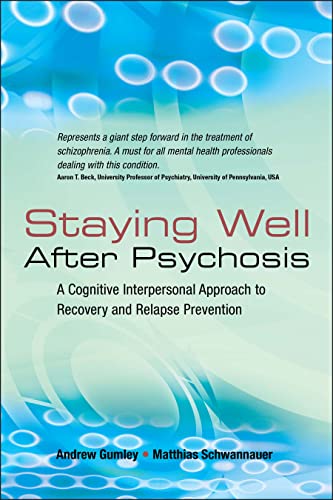
Staying Well After Psychosis by Andrew Gumley
Staying Well After Psychosis Staying Well After Psychosis is extremely readable, based on solid research evidence and packed full of clinical insights and strategies that will satisfy any clinician seeking innovative approaches to the promotion of recovery from psychosis. Anthony P. Morrison, Professor of Clinical Psychology, University of Manchester, UK Over the past decade our understanding of the experience of psychosis has changed dramatically. As part of this change, a range of psychological models of psychosis and associated interventions have developed. Staying Well After Psychosis presents an individually based psychological intervention targeting emotional recovery and relapse prevention. This approach considers the cognitive, interpersonal and developmental aspects involved in recovery and vulnerability to the recurrence of psychosis. Andrew Gumley and Matthias Schwannauer provide a framework for recovery and staying well that focuses on emotional and interpersonal adaptation to psychosis. This practical manual covers, in detail, all aspects of the therapeutic process of Cognitive Interpersonal Therapy, including: Taking a developmental perspective on help seeking and affect regulation. Supporting self-reorganisation and adaptation after acute psychosis. Understanding and treating traumatic reactions to psychosis. Working with feelings of humiliation, entrapment, loss and fear of recurrence. Working with cognitive interpersonal schemata. Developing coping in an interpersonal context. Clinical psychologists, psychiatrists and mental health professionals will find this innovative treatment manual to be a valuable resource in their work with adults and adolescents. This book will also be of interest to lecturers and students of clinical psychology and mental health.
"..extends our understanding of psychosis…extremely helpful for therapists working with psychotic patients who are at risk of relapse." (Behaviour and Cognitive Psychotherapy, May 2007)
Andrew Gumley is Senior Lecturer in Clinical Psychology on the University of Glasgow Doctorate in clinical Psychology training Programme, a practising clinician as Honorary Consultant Clinical Psychologist in ESTEEM, North Glasgow Early Intervention Service, a trainer in cognitive behavioural psychotherapy at the Glasgow Institute for Psychosocial Interventions (GIPSI) and external consultant to the State Hospital at Carstairs Psychosocial Interventions Programme. His research interests include the evaluation of cognitive behavioural therapies for individuals who are considered to have seer and enduring mental health problems. In recent years, he has contributed to a number of randomised controlled trials of cognitive therapy involving individuals who have had or are recovering from distressing psychotic experiences, and individuals who have been diagnosed with borderline and antisocial personality disorders. His primary clinical and research interests focus on developing a psychological understanding of individual vulnerability and transition to he recurrence of psychosis. In this context Andrew is particularly interested in how the interplay between the experiences of psychosis and cognitive and interpersonal factors may prevent detection of at-risk mental states for relapse, contribute to affect dysregulation during relapse, or result in persistent and distressing emotional states such as fear of recurrence. These clinical and research interests are directed towards the development, refinement and evaluation of psychological therapies for recovery and staying well after psychosis. Matthias Schwannauer is Lecturer and Research Supervisor in Child and Adolescent Clinical Psychology on the University of Edinburgh Clinical Psychology Training Course, Research Co-ordinator in the Young People's Unit in Edinburgh and Practising clinician as consultant clinical Psychologist in an adolescent onset psychosis service in Lothian. His current clinical and research interest include the relationship between interpersonal and cognitive factors in developmental models of server and enduring disorder groups. He is particularly interested in the developmental onset of sever mental health problems with regard to psychological factors of vulnerability and resilience to psychiatric disorders. In the past few years Matthias has investigated developmental models of interpersonal and cognitive aspects of emotion regulation in a number of populations, such as depression in a highly vulnerable group of single, young homeless adolescents with an early onset psychosis and individuals suffering from bipolar disorder. He is interested in the advancement of a developmental psychopathology model of affect regulation in a range of populations with severe and recurring psychological difficulties.
| SKU | Unavailable |
| ISBN 13 | 9780470021859 |
| ISBN 10 | 0470021853 |
| Title | Staying Well After Psychosis |
| Author | Andrew Gumley |
| Condition | Unavailable |
| Binding Type | Paperback |
| Publisher | John Wiley & Sons Inc |
| Year published | 2006-01-27 |
| Number of pages | 320 |
| Cover note | Book picture is for illustrative purposes only, actual binding, cover or edition may vary. |
| Note | Unavailable |