


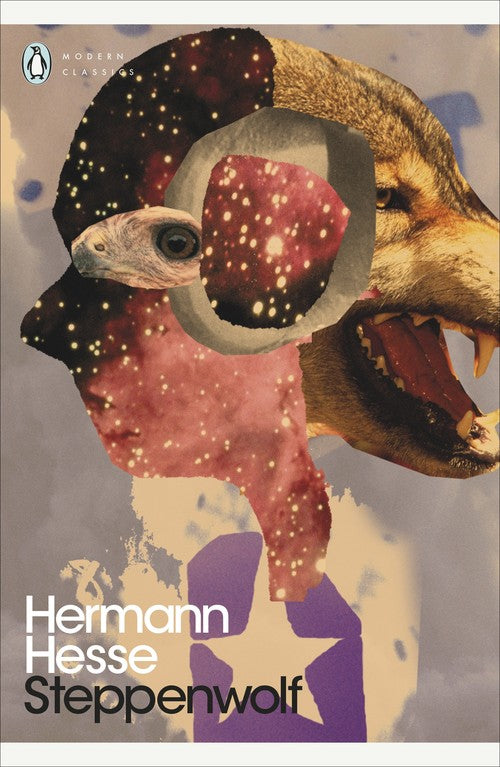
Steppenwolf by Hermann Hesse
At first sight Harry Haller seems a respectable, educated man. In reality he is the Steppenwolf: wild, strange, alienated from society and repulsed by the modern age. But as he is drawn into a series of dreamlike and sometimes savage encounters - accompanied by, among others, Mozart, Goethe and the bewitching Hermione.-
 Of Mice and Men
-
 The Great Gatsby
-
 East of Eden
-
 A Month in the Country
-
 Giovanni's Room
-
 In Cold Blood
-
 An Inspector Calls and Other Plays
-
 A Streetcar Named Desire
-
 Animal Farm
-
 Alone in Berlin
-
 Wide Sargasso Sea
-
 The Spy Who Came in from the Cold
-
 The Grapes of Wrath
-
 The Man in the High Castle
-
 On the Road
-
 Nineteen Eighty-Four
-
 One Flew Over the Cuckoo's Nest
-
 Lolita
-
 Brideshead Revisited
-
 The Haunting of Hill House
-
 We Have Always Lived in the Castle
-
 A Clockwork Orange
-
 Orientalism
-
 One Hundred Years of Solitude
-
 The Crucible
-
 Ways of Seeing
-
 Breakfast at Tiffany's
-
 A Confederacy of Dunces
-
 Tokyo Express
-
 Death of a Salesman
-
 The Wretched of the Earth
-
 Things Fall Apart
-
 The Lonely Londoners
-
 Down and Out in Paris and London
-
 Dubliners
-
 The Prime of Miss Jean Brodie
-
 The Night Manager
-
 Pedagogy of the Oppressed
-
 One Day in the Life of Ivan Denisovich
-
 The Myth of Sisyphus
-
 Mrs Dalloway
-
 Caliban and the Witch
-
 The Road to Wigan Pier
-
 Homage to Catalonia
-
 Ulysses
-
 The Go-between


The gripping and fascinating story of disease in a man's soul * The New York Times *
Herman Hesse was born in southern Germany in 1877. Hesse concentrated on writing poetry as a young man, but his first successful book was a novel, Peter Camenzind (1904). During the war, Hesse was actively involved in relief efforts. Depression, criticism for his pacifist views, and a series of personal crises led Hesse to undergo psychoanalysis with J. B. Lang. Out of these years came Demian (1919), a novel whose main character is torn between the orderliness of bourgeois existence and the turbulent and enticing world of sensual experience. This dichotomy is prominent in Hesse's subsequent novels, including Siddhartha (1922), Steppenwolf (1927), and Narcissus and Goldmund (1930). Hesse worked on his magnum opus, The Glass Bead Game (1943), for twelve years. This novel was specifically cited when he was awarded the Nobel Prize for Literature in 1946. Hesse died at his home in Switzerland in 1962.
| SKU | Unavailable |
| ISBN 13 | 9780141192093 |
| ISBN 10 | 0141192097 |
| Title | Steppenwolf |
| Author | Hermann Hesse |
| Series | Penguin Modern Classics |
| Condition | Unavailable |
| Binding Type | Paperback |
| Publisher | Penguin Books Ltd |
| Year published | 2012-04-05 |
| Number of pages | 272 |
| Cover note | Book picture is for illustrative purposes only, actual binding, cover or edition may vary. |
| Note | Unavailable |