


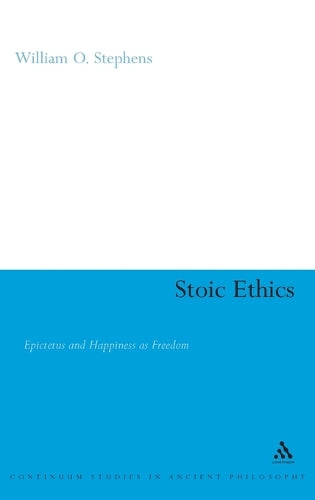
Stoic Ethics by William O Stephens
Shortly after Aristotle's death, ancient philosophy shifted away from abstract technical issues and focused on the more practical moral question of how to be happy. While many schools of thought arose on the subject, Stoicism and Epicureanism dominated the philosophical landscape for nearly 500 years, often locked in bitter rivalry with each other. Epicureanism advised pursing pleasure as a means to happiness, and Stoicism held that true happiness could only be achieved by accepting one's assigned lot in life. The lasting impact of these philosophies is seen from that fact that even today 'Stoic' and 'Epicurean' are household words. Although the founder of Stoicism was an obscure Greek philosopher who wrote nothing on the subject, his school consistently attracted more followers than its Epicurean counterpart. Little, in fact, survives of early Stoicism, and our knowledge of it comes largely from a few later Stoics. In this unique book, William O. Stephens explores the moral philosophy of Epictetus, a former Roman slave and dynamic Stoic teacher whose writings are the most compelling defence of ancient Stoicism that exists. Epictetus' philosophy dramatically captures the spirit of Stoicism by examining our greatest human disappointments, such as the death of a loved one. Stephens shows how, for Epictetus, happiness results from focusing our concern on what is up to us while not worrying about what is beyond our control. He concludes that the strength of Epictetus' philosophy lies in his conception of happiness as freedom from fear, worry, grief, and dependence upon luck.
"This monograph contains several insightful and subtle comments on Epictetan and Stoic ethics, and is of interest to anyone looking for a philosophical treatment of certain problems to which they give rise.. One attractive feature of the book is the author's engagement with general philosophical issues and the frequent comparison he makes between Epictetus and modern thinkers, for example, Erich Fromm (108-9 and 119 n. 9). Stephens' personal opinion on the strengths and weaknesses of Stoic and Epictetan ethics is carefully presented at the end (150-154). From this perspective, and considering also the great clarity with which it is written and the numerous quotations from Epictetus, Stoic Ethics: Epictetus and Happiness as Freedom may be used as a good general introduction to this major Stoic philosopher." - Notre Dame Philosophical Reviews -- Ricardo Salles
"The book is a fresh and valuable overview of Stoic ethical themes as presented in Epictetus's writings. Its own writing is graceful, the examples are fascinating, and careful and thorough attention to the texts of Epictetus brings to light many bits of Epictetus which will be unfamiliar to those who have read only the Encheiridion...It makes an important contribution to our understanding of Roman Stoics' mighty struggle to find happiness in a turbulent and uncontrollable world which is, in those respects, much like our own." -Eve A. Browning, Bryn Mawr Classical Review, 2010
"The book is a fresh and valuable overview of Stoic ethical themes as presented in Epictetus's writings. Its own writing is graceful, the examples are fascinating, and careful and thorough attention to the texts of Epictetus brings to light many bits of Epictetus which will be unfamiliar to those who have read only the Encheiridion...It makes an important contribution to our understanding of Roman Stoics' mighty struggle to find happiness in a turbulent and uncontrollable world which is, in those respects, much like our own." -Eve A. Browning, Bryn Mawr Classical Review, 2010
William O. Stephens teaches philosophy at Creighton University, Nebraska, USA. Publications include numerous journal articles and book chapters, plus a translation of Bonhoffer's The Ethics of the Stoic Epictetus (Peter Lang, 1996) and The Person (Prentice Hall, 2005).
| SKU | Unavailable |
| ISBN 13 | 9780826496089 |
| ISBN 10 | 0826496083 |
| Title | Stoic Ethics |
| Author | William O Stephens |
| Series | Continuum Studies In Ancient Philosophy |
| Condition | Unavailable |
| Binding Type | Hardback |
| Publisher | Bloomsbury Publishing PLC |
| Year published | 2007-05-10 |
| Number of pages | 208 |
| Cover note | Book picture is for illustrative purposes only, actual binding, cover or edition may vary. |
| Note | Unavailable |