
Structural Functions of Harmony


Summary
The feel-good place to buy books
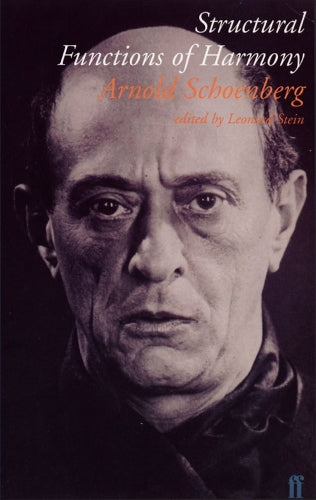
Structural Functions of Harmony by Arnold Schoenberg
First published in 1948, Structural Functions of Harmony is Schoenberg's last theoretical work and contains his ultimate thoughts on classical and romantic harmony. The opening chapters are a resume of the basic principles of the early Theory of Harmony; the subsequent chapters demonstrate the concept of 'monotonality', whereby all modulations to different keys within a movement are analysed not in relation to each other but in terms of the irrelationship to one central tonality (tonic) as the centre of all harmonic change. Schoenberg's music examples range from the entire development sections of classical symphonies to analyses of the harmonic progressions of Strauss, Debussy, Reger, and his own early music.
Arnold Schoenberg (1874-1951) was an Austrian composer, later moving to the United States, and was leader of the Second Viennese School. In the 1920s, Schoenberg developed the twelve-tone technique, and his approach, both in terms of harmony and development, is among the major landmarks of twentieth-century musical thought. The extraordinary scope of Schoenberg's intelligence, and the often prophetic character of his insights, make his writings on music an indispensable source for anyone interested in the complex history of twentieth-century music.
| SKU | Unavailable |
| ISBN 13 | 9780571196579 |
| ISBN 10 | 0571196578 |
| Title | Structural Functions of Harmony |
| Author | Arnold Schoenberg |
| Condition | Unavailable |
| Binding Type | Paperback |
| Publisher | Faber & Faber |
| Year published | 1999-03-15 |
| Number of pages | 224 |
| Cover note | Book picture is for illustrative purposes only, actual binding, cover or edition may vary. |
| Note | Unavailable |