


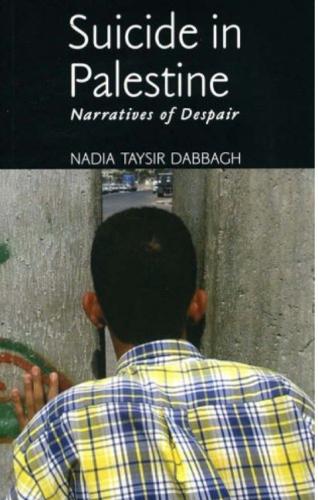
Suicide in Palestine by Nadia Dabbagh
This book is a pioneering anthropological study of suicide in the contemporary Arab world. It discusses the effects of life under the Israeli occupation on the mental health of young Palestinians, using selected case studies of men and women who attempted suicide in the West Bank, above all in the city of Ramallah, but also in Jenin. This is not a book about martyrs, or those who gain so much media attention by dying for a 'holy cause'; rather it concerns those who wish to die for entirely private reasons. Contrary to wider expectations, fatal suicide levels in Palestinian society remain low compared with Western norms, not withstanding the many stress factors that have been shown to contribute to suicidal behavior in the West, including unemployment and social deprivation. Above all, suicide is found to be contrary to the concept of Palestinian identity, of a people under siege for whom resistance is paramount, rather than succumbing to depression or despair.Above all, Nadia Dabbagh's findings bear out the salience of what she calls 'the ripple effects of war'. Her research was carried out after the first intifada, during a so-called 'peace-building' period, but her research clearly bears out the trauma of Palestinians living in the Occupied Territories. The stories she collected mirror the disillusionment of many Palestinians who had hoped that their lives would improve once fighting subsided and the Palestinian National Authority had been established. The book aims to foster an understanding of suicide in the Islamic world, looking at current and historical attitudes to death and self-killing in Islamic or Arab thought. The distinction between suicide and martyrdom is explored in detail, as are current perceptions of these phenomena in the Muslim world.
'Dr Dabbagh's research in Ramallah in the late 1990s produced a series of extraordinary narrativesfrom young men and women in despair who tried to kill themselvesShe is a brilliant interviewer and listener, and, as a young doctor she had access to hospitals, and as a woman access to families, which brought her stories rarely told to outsiders.The book is set firmly in the political context of Palestinian history. [A...] From her first visits to the West Bank, as a student with UK nationality, Dabbagh began noting 'the ripple effect of war and occupation'-the daily humiliation, the strangled economy and the corrosion of unemployment. This context has of course worsened since she did her research, but that only makes these stories more poignant and important to tell.' * Victoria Brittain, Palestine News *
'[A...] Palestinians, particularly organisers of suicide bombing, insist on making a clear distinction between conventional suicide and suicide bombing: the first is a reprehensible private act, while the second is a revered form of martyrdom. If anything, Dabbagh shows that suicidal people in Palestine tend to do what suicidal people do everywhere: that is, kill themselves by taking an overdose, not blow themselves up on the streets of Tel Aviv.' * The Guardian *
'[A...] Palestinians, particularly organisers of suicide bombing, insist on making a clear distinction between conventional suicide and suicide bombing: the first is a reprehensible private act, while the second is a revered form of martyrdom. If anything, Dabbagh shows that suicidal people in Palestine tend to do what suicidal people do everywhere: that is, kill themselves by taking an overdose, not blow themselves up on the streets of Tel Aviv.' * The Guardian *
NADIA DABBAGH, a doctor of Palestinian descent, practises as a psychologist in England.
| SKU | Unavailable |
| ISBN 13 | 9781850657903 |
| ISBN 10 | 1850657904 |
| Title | Suicide in Palestine |
| Author | Nadia Dabbagh |
| Condition | Unavailable |
| Binding Type | Paperback |
| Publisher | C Hurst & Co Publishers Ltd |
| Year published | 2005-03-04 |
| Number of pages | 274 |
| Cover note | Book picture is for illustrative purposes only, actual binding, cover or edition may vary. |
| Note | Unavailable |