
Synergetic Computers and Cognition


Synergetic Computers and Cognition
Regular price
Checking stock...
Regular price
Checking stock...
Summary
The first edition of this book has found great interest among scientists and en gineers dealing with pattern recognition and among psychologists working on psychophysics or Gestalt psychology.
The feel-good place to buy books
- Free US shipping over $15
- Buying preloved emits 41% less CO2 than new
- Millions of affordable books
- Give your books a new home - sell them back to us!
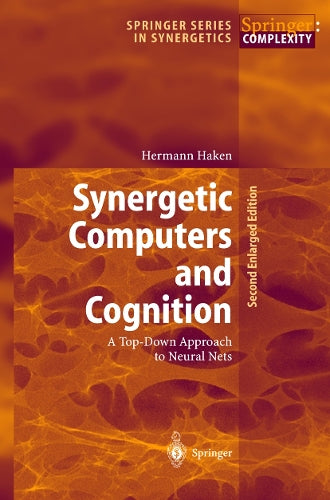
Synergetic Computers and Cognition by Hermann Haken
The first edition of this book has found great interest among scientists and en gineers dealing with pattern recognition and among psychologists working on psychophysics or Gestalt psychology. This book also proved highly useful for graduate students of informatics. The concept of the synergetic computer offers an important alternative to the by now more traditional neural nets. I just mention a few advantages: There are no ghost states so that time-consuming methods such as simulated annealing can be avoided; the synaptic strengths are explicitly determined by the prototype patterns to be stored, but they can equally well be learned, and the learning procedure allows a classification. Also a precise meaning and function can be attributed to "hidden variables". The synergetic computer has found a number of important practical applications in industry. I use the opportunity of this second edition to include a new section on transfor mation properties of the equations of the synergetic computer and on the invariance properties of its order parameter equations. A new section is devoted to the problem of stereopsis that is dealt with by the basic concept of the synergetic computer. Finally, attention is paid to a recent de velopment, namely to the use of pulse-coupled neural nets for pattern recognition.
Hermann Haken is Professor of the Institute for Theoretical Physics at the University of Stuttgart. He is known as the founder of synergetics. His research has been in nonlinear optics (in particular laser physics), solid state physics, statistical physics, and group theory. After the implementation of the first laser in 1960, Professor Haken developed his institute to an international center for laser theory. The interpretation of the laser principles as self organization of non equilibrium systems paved the way to the development of synergetics, of which Haken is recognized as the founder. Hermann Haken has been visiting professor or guest scientist in England, France, Japan, USA, Russia, and China. He is the author of some 23 textbooks and monographs that cover an impressive number of topics from laser physics to synergetics, and editor of a book series in synergetics. For his pathbreaking work and his influence on academic research, he has been awarded many-times. Among others, he is member of the Order Pour le merite and received the Max Planck Medal in 1990.
Paul Levi is Full Professor for Informatics in the Institute for Parallel and Distributed Systems of the University of Stuttgart, Germany. He graduated in physics and computer science and became a senior research scientist in informatics and robotics, and Head of the Department of Technical Expert Systems and Robotics at the University of Karlsruhe. In 1988 he was appointed Professor at the Technical University of Munich, and scientific member of the Bavarian Center for Knowledge-Based Systems. Later on he served as Director of the Institute for Parallel and Distributed High Performance Computers at the University of Stuttgart. He is Member of the Management Board of the Centre for Computer Science (FZI) and Director of the Division Intelligent Systems and Production Engineering (ISPE), Karlsruhe, Germany.
Paul Levi's main research fields include computer vision, robotics, distributed AI and multi-agent systems. He has authored and co-authored both textbooks and monographs.
Paul Levi is Full Professor for Informatics in the Institute for Parallel and Distributed Systems of the University of Stuttgart, Germany. He graduated in physics and computer science and became a senior research scientist in informatics and robotics, and Head of the Department of Technical Expert Systems and Robotics at the University of Karlsruhe. In 1988 he was appointed Professor at the Technical University of Munich, and scientific member of the Bavarian Center for Knowledge-Based Systems. Later on he served as Director of the Institute for Parallel and Distributed High Performance Computers at the University of Stuttgart. He is Member of the Management Board of the Centre for Computer Science (FZI) and Director of the Division Intelligent Systems and Production Engineering (ISPE), Karlsruhe, Germany.
Paul Levi's main research fields include computer vision, robotics, distributed AI and multi-agent systems. He has authored and co-authored both textbooks and monographs.
| SKU | Unavailable |
| ISBN 13 | 9783540421634 |
| ISBN 10 | 3540421637 |
| Title | Synergetic Computers and Cognition |
| Author | Hermann Haken |
| Series | Springer Series In Synergetics |
| Condition | Unavailable |
| Publisher | Springer-Verlag Berlin and Heidelberg GmbH & Co. KG |
| Year published | 2004-06-15 |
| Number of pages | 245 |
| Cover note | Book picture is for illustrative purposes only, actual binding, cover or edition may vary. |
| Note | Unavailable |