
Ten Precepts of Dialogue


World of Books
The feel-good place to buy books
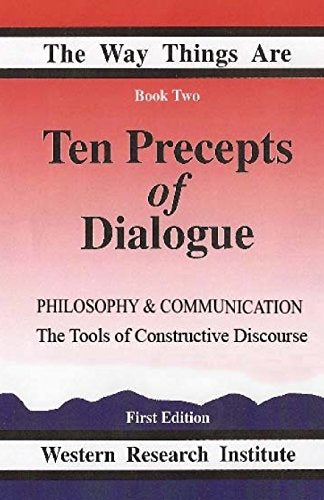
Ten Precepts of Dialogue by Charles Hoppins
Dialogue can at times be truly magical, dissolving the boundaries between us and the world and opening up wellsprings of realization and resonant power. In those rare, deeply healing moments of dialogue in its most ideal form, we may experience the wholeness of who we are. So says Tom Atlee who authors the Co-Intelligence Institute at www.cointelligence.org. We define dialogue as constructive discourse between two or more people about a specific subject. By constructive discourse, we mean discourse that is meaningful to the parties involved and that produces greater understanding of the subject under discussion. Ultimately this means a greater understanding of truth and the way things are in reality, which includes solutions of problems and coming to terms or agreement between the parties involved. The Ten Precepts of Dialogue are rules which when followed produce the above results. The Ten Precepts of Dialogue are the communicator's Bill of Rights so to speak, which encompass our ground rules for meaningful communication.
Charles Hoppins is a semi-retired journalist with a passion for philosophy enhanced by formal graduate study and a lot of research. He has worked for The Associated Press and a number of newspapers as writer, assistant city editor, state editor and wire editor. Reporters working for news organizations are under constant pressure to produce copy and meet deadlines. The stories they cover often have serious ramifications that are dealt with only on a superficial basis. Troubled by the lack of time to do serious in depth reporting on a number of stories, he conceived of the idea of a research institution that would have the funding and ability to cover stories that would otherwise not see the light of day. In 1987, he was a principle in the founding of Western Research Institute (WRI). From its inception WRI set out to do in-depth reporting on a number of issues. It has done reports and published books on technology, law, government, philosophy and communication. For the past number of years he has been involved in the study of the prevalence of certain philosophical positions and how those positions affect society, human behavior and public policy. He has completed a number of books on the results, the last involving precepts of dialogue and general principles of communication. The outcome of these studies, is the publication of Rules for Public Discourse, on how to hold lawmakers, candidates for public office and others accountable for what they say for public consumption. As part of WRI's commitment to public interest research, he has in collaboration with Jerry Fenning embarked on an in-depth research project involving reports on How America Can Stop Importing Foreign Oil and The Fight Over Using Natural Gas for Transportaion.. How America Can Stop Importing Foreign Oil is available in a print edition and an ebook edition. The ebook edition is available on Kindle, Nook, Smashwords.com and Apple and Google devices.
| SKU | Unavailable |
| ISBN 13 | 9781882567300 |
| ISBN 10 | 1882567307 |
| Title | Ten Precepts of Dialogue |
| Author | Charles Hoppins |
| Series | The Way Things Are |
| Condition | Unavailable |
| Binding Type | Paperback |
| Publisher | Western Research Institute, Incorporated |
| Year published | 2016-08-25 |
| Number of pages | 130 |
| Cover note | Book picture is for illustrative purposes only, actual binding, cover or edition may vary. |
| Note | Unavailable |