


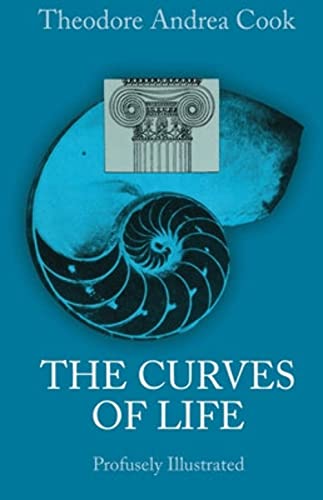
The The Curves of Life by Theodore Andrea Cook
The open-ended curve of the spiral gives a sensation of continuous motion -- of life, in fact. In The Curves of Life, Sir Theodore A. Cook (1867-1928), English author and editor, finds that the spiral or helix may lie at the core of life's first principle -- that of growth. The spiral is fundamental to the structure of plants, shells, and the human body; to the periodicity of atomic elements and to an animal's horns; to microscopic DNA (the double helix) and to the Andromeda nebula.
The Curves of Life portrays the significance of the spiral in 426 illustrations, from a Narwhal's tusk to Dürer's plan for a cylindrical helix. From the spiral in nature, science, and art, the author suggests ideas on the essence of beauty and man's response to it. "One of the chief beauties of the spiral as an imaginative conception is that it is always growing, yet never covering the same ground, so that it is not merely an explanation of the past, but is also a prophecy of the future."
Martin Gardner, mathematician and author, said of The Curves of Life, "This is the classic reference on how the golden ratio applies to spirals and helices in nature."
| SKU | Unavailable |
| ISBN 13 | 9780486237015 |
| ISBN 10 | 048623701X |
| Title | The The Curves of Life |
| Author | Theodore Andrea Cook |
| Series | Dover Books Explaining Science |
| Condition | Unavailable |
| Binding Type | Paperback |
| Publisher | Dover Publications Inc. |
| Year published | 2003-03-28 |
| Number of pages | 528 |
| Cover note | Book picture is for illustrative purposes only, actual binding, cover or edition may vary. |
| Note | Unavailable |