


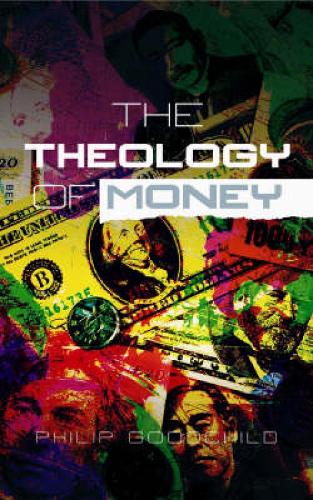
Theology of Money by Philip Goodchild
Goodchild examines the theory of money in a comparable manner to Adam Smith, Karl Marx and Georg Simmel. However by contrast to the conclusions of these thinkers, he proposes that money is essentially created in excess of reserves, making it a simultaneous credit and debt. Since money is a debt that must be repaid with interest in the form of money, then the creation of money imposes a social demand for an increase in profit and an increase in the creation of money in order to repay debt. This vicious circle drives the expansion of the global economy. In summary, Goodchild argues that money is a promise, a supreme value, a transcendent value and an obligation or a law. He argues that money has taken the place of God. It is the dominant global religion in practice, even if no one believes in it in principle.
'Goodchild's book is recommended for those interested in either political theology or how economics might intersect with theology, but would be less helpful for those looking for practical solutions or biblical reflections on money'-- Geoffrey Holsclaw * Evangelical Review *
Philip Goodchild came to prominence as one of the earliest generation of scholars of Deleuze, and he has also made a significant contribution to Continental philosophy of religion with two edited volumes, Rethinking Philosophy of Religion, 2002 and Difference in Philosophy of Religion, 2003. His major monograph, Capitalism and Religion: The Price of Piety, 2002 was described as 'a defining book of the decade'. This book develops these ideas further.
| SKU | Unavailable |
| ISBN 13 | 9780334041429 |
| ISBN 10 | 0334041422 |
| Title | Theology of Money |
| Author | Philip Goodchild |
| Condition | Unavailable |
| Binding Type | Paperback |
| Publisher | SCM Press |
| Year published | 2007-10-30 |
| Number of pages | 277 |
| Cover note | Book picture is for illustrative purposes only, actual binding, cover or edition may vary. |
| Note | Unavailable |