


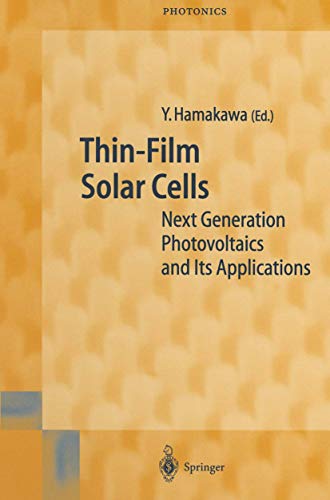
Thin-Film Solar Cells by Yoshihiro Hamakawa
The development of clean energy resources as alternatives to oiI has become one of the most important challenges for modern science and technology. The obvious motivation for these efforts is to reduce the air polIution resulting from the mass consumption of fossil fuels and to protect the ecological cycles of the biosystems on Earth. Analyses of future energy usage envision that the energy structure in the 21st century will be characterized as a "Best Mix Age" involving different renewable energy forms. Among the wide variety of renewable energy projects in progress, photo voltaics is the most promising as a future energy technology. It is pollution free and abundantly available everywhere in the world, even in space, and can also operate with diffuse light. However, a major barrier impeding the devel opment of large-scale bulk power applications of photovoltaic systems is the high price of solar cell modules. Therefore, reduction of the costs of solar celIs is of prime importance. To achieve this objective, tremendous R&D efforts have been made over the past two decades in a wide variety of technical fields ranging from solar-cell materials, cell structure, and mass production pro cesses to the photovoltaic systems themselves. As the result, about an order of magnitude cost reduction has been achieved in the past 10 years.| SKU | Unavailable |
| ISBN 13 | 9783642078798 |
| ISBN 10 | 3642078796 |
| Title | Thin-Film Solar Cells |
| Author | Yoshihiro Hamakawa |
| Series | Springer Series In Photonics |
| Condition | Unavailable |
| Binding Type | Paperback |
| Publisher | Springer |
| Year published | 2011-03-27 |
| Number of pages | 244 |
| Cover note | Book picture is for illustrative purposes only, actual binding, cover or edition may vary. |
| Note | Unavailable |