
Thomas Kuhn's Revolutions


World of Books
The feel-good place to buy books
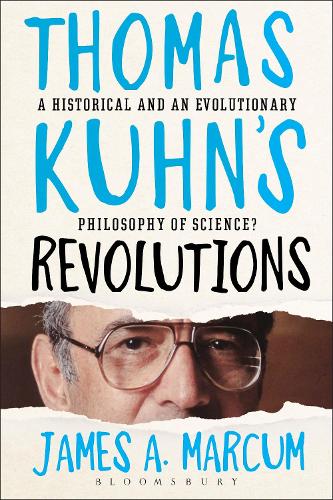
Thomas Kuhn's Revolutions by James A Marcum
The influence of Thomas Kuhn (1922 -1996) on the history and philosophy of science has been truly enormous. In 1962, Kuhn's famous work, The Structure of Scientific Revolutions, helped to inaugurate a revolution - the historiographic revolution - in the latter half of the twentieth century, providing a new understanding of science in which 'paradigm shifts' (scientific revolutions) are punctuated with periods of stasis (normal science). Kuhn's revolution not only had a huge impact on the history and philosophy of science but on other disciplines as well, including sociology, education, economics, theology, and even science policy. James A. Marcum's book focuses on the following questions: What exactly was Kuhn's historiographic revolution? How did it come about? Why did it have the impact it did? What, if any, will its future impact be for both academia and society? At the heart of the answers to these questions is the person of Kuhn himself, i.e., his personality, his pedagogical style, his institutional and social commitments, and the intellectual and social context in which he practiced his trade. Drawing on the rich archival sources at MIT, and engaging fully with current scholarship on Kuhn, Marcum's is the first book to show in detail how Kuhn's influence transcended the boundaries of the history and philosophy of science community to reach many others - sociologists, economists, theologians, political scientists, educators, and even policy makers and politicians.
A valuable resource for Kuhn scholars and all those interested specifically in a contextualization of Structure of Scientific Revolutions or searching for a comprehensive overview of the secondary literature on Kuhn in philosophy and beyond* Metascience *
Marcum has masterfully captured Kuhn’s contributions to philosophy and history of science with useful biographical information, insightful interpretations, and resourceful selection of the vast secondary literature on Kuhn and the wide impact of his thinking. Simply, Thomas Kuhn’s Revolutions is a noteworthy study and will serve as one of the key texts for placing Kuhn in his intellectual context. -- Alfred I. Tauber, Professor Emeritus of Philosophy, and Zoltan Kohn Professor Emeritus of Medicine, Boston University, USA
Thomas Kuhn’s The Structure of Scientific Revolutions is the most important work in the philosophy of science in the twentieth century. James Marcum’s is simply the best book that has ever been written on Kuhn’s thinking, both in Structure and in writings before and after. It is fair-minded, clearly written, comprehensive, and with enough of a critical edge that you want to go on studying Kuhn and seeing how he still applies to issues that concern us. This is the book we have been waiting for. -- Michael Ruse, Lucyle T. Werkmeister Professor of Philosophy, Florida State University, USA
Kuhn's Structure is a modern classic and yet its genesis has not so far had the attention it deserves. James Marcum’s book fulfils magnificently this lacuna giving us not only the rich details of how the book came to be written but also its intellectual and wider contributions, its impact and the criticism it received. The author’s personal connection to Kuhn and the focus on Kuhn’s personality make the reading all the more enjoyable. -- Vasso Kindi, Associate Professor of Philosophy, University of Athens, Greece
Marcum has masterfully captured Kuhn’s contributions to philosophy and history of science with useful biographical information, insightful interpretations, and resourceful selection of the vast secondary literature on Kuhn and the wide impact of his thinking. Simply, Thomas Kuhn’s Revolutions is a noteworthy study and will serve as one of the key texts for placing Kuhn in his intellectual context. -- Alfred I. Tauber, Professor Emeritus of Philosophy, and Zoltan Kohn Professor Emeritus of Medicine, Boston University, USA
Thomas Kuhn’s The Structure of Scientific Revolutions is the most important work in the philosophy of science in the twentieth century. James Marcum’s is simply the best book that has ever been written on Kuhn’s thinking, both in Structure and in writings before and after. It is fair-minded, clearly written, comprehensive, and with enough of a critical edge that you want to go on studying Kuhn and seeing how he still applies to issues that concern us. This is the book we have been waiting for. -- Michael Ruse, Lucyle T. Werkmeister Professor of Philosophy, Florida State University, USA
Kuhn's Structure is a modern classic and yet its genesis has not so far had the attention it deserves. James Marcum’s book fulfils magnificently this lacuna giving us not only the rich details of how the book came to be written but also its intellectual and wider contributions, its impact and the criticism it received. The author’s personal connection to Kuhn and the focus on Kuhn’s personality make the reading all the more enjoyable. -- Vasso Kindi, Associate Professor of Philosophy, University of Athens, Greece
James Marcum teaches philosophy at Baylor University, USA. He has doctorates in philosophy and physiology, and was a postdoctoral fellow at MIT, where he studied philosophy of science with Kuhn. He was also an Assistant Professor at Harvard Medical School, USA.
| SKU | Unavailable |
| ISBN 13 | 9781472530493 |
| ISBN 10 | 1472530497 |
| Title | Thomas Kuhn's Revolutions |
| Author | James A Marcum |
| Condition | Unavailable |
| Binding Type | Paperback |
| Publisher | Bloomsbury Publishing PLC |
| Year published | 2015-10-22 |
| Number of pages | 304 |
| Cover note | Book picture is for illustrative purposes only, actual binding, cover or edition may vary. |
| Note | Unavailable |